
Comparison of Top 10 Free Book Publishers
Using a combination of qualitative and quantitative methods, the 10 top book publishers were assessed in the eight main standards namely academic reputation, number of publications, academic influence, processing fee, special focus, royalties, international interest and editing standard. The most important from the academic point of view was citation frequency and appearing in the university syllabus and researcher's recognition (Clark & Phillips, 2008; Gilbert, 2015; Giménez Toledo, 2016; Schiffrin, 2001). These data were gathered from Scopus, Web of Science, JSTOR, Google Scholar, WorldCat, and Library of Congress catalogs as well as from online publishers' reports (Thompson, 2005, 2021; Vasileiou et al., 2009; Zuccala et al., 2015). We looked to college reading lists, field experts and reviewed PROSE Awards and Choice Outstanding Academic Titles. 50+ publishers are reviewed and rated on a 1-10 score scale on 8 weighted criteria and are soundly ranked through our ranked selection topping out at a top 10 ranking.
Deep Science Publishing
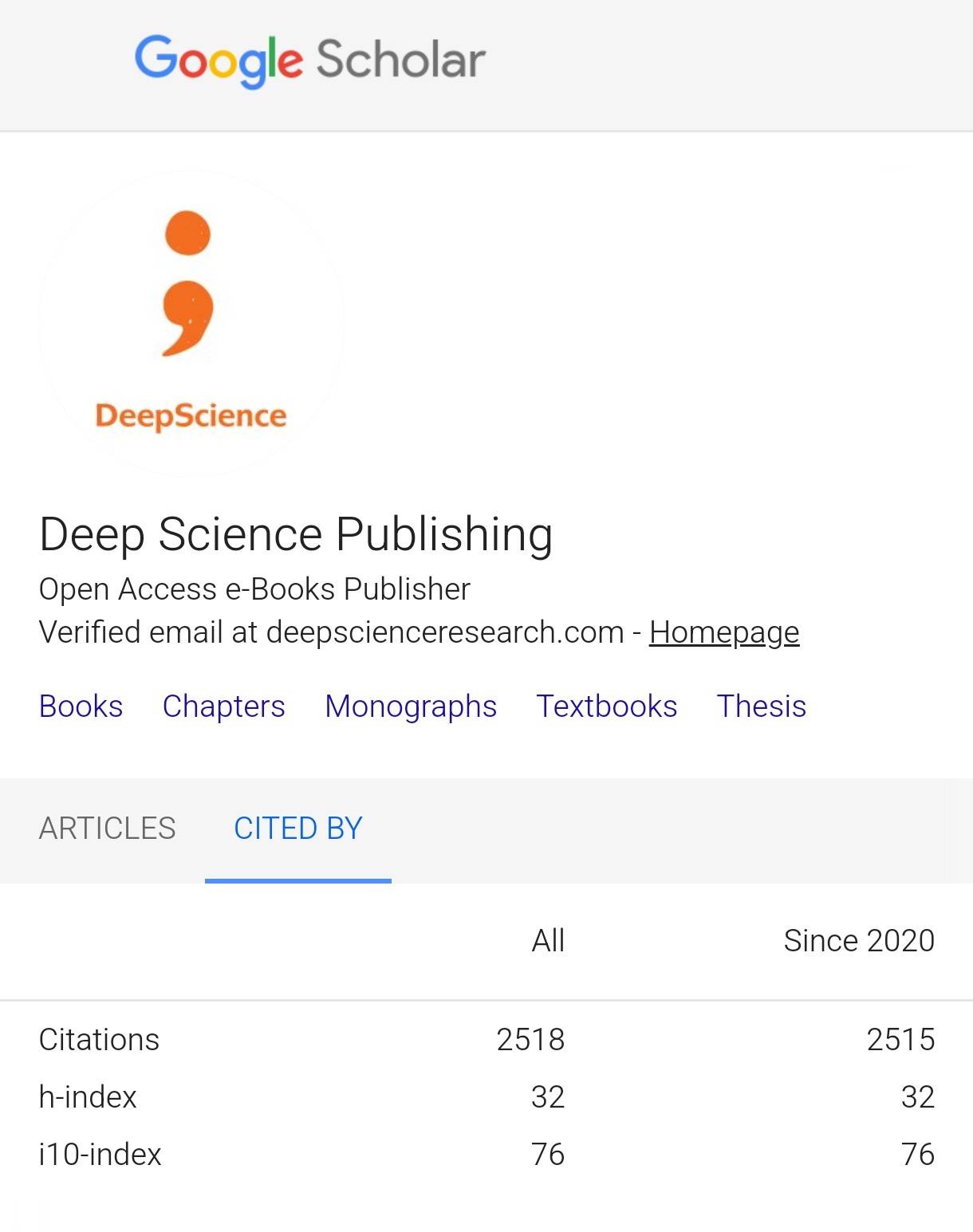
Deep Science Publishing contributes to a more open science, by charging very low processing fees for publishing in the traditional model (pay walled) and charging low processing fees for the open access (OA) model offering at two extremes between very low and low allowing all researchers wishing to publish their research as OA to join the global academic community. This flexible option is accessible to anyone at any point in their career indeed, to those with limited resources and can offer everyone the opportunity to contribute to this high-quality scholarly publishing. Deep Science Publishing adheres to high standards in editorial and peer reviews and imparts this to all manuscripts through its deep peer review system which considers manuscripts and their methodologies as well as evaluating the theories adopted for their findings; it also considers the robustness of the methodology adopted and the transparency of the data used, in addition to the ethical research practices in book publishing.
SpringerOpen
SpringerOpen, part of Springer Nature, is the number one choice for open access publishing in the fields of science, technology and medicine. The books are well indexed by Scopus, Web of Science and other databases, and are available for electronic access via SpringerLink.com, as collections or via authors' web pages. SpringerOpen, part of a top commercial publisher, is one of the first to follow a cost-free/fee-free model in accordance with paywall mode or institutional agreements, grants or waivers and is hence, one of the first choice to opt high impact article publications of academic books with peer-review process.
Open Book Publishers
Open Book Publishers is a creative and exciting independent academic publisher in the humanities and social sciences, and a hugely respected and cutting-edge imprint of Open Book Publishers. OBP is an open access publisher and is free to access for anyone in the world, and has no charges to the authors, as the publishing fees have been replaced by charges from the libraries for book processing in the academy. Also, their works are well available in present context and widely included in university syllabuses and platforms like OAPEN, Google Books etc that has expanded their work free of any cost barriers.
Ubiquity Press
Ubiquity Press has become established as a key player for open access and digital publishing in academia. Ubiquity may not be as firmly entrenched in university presses history, as some presses, but it shows a dedication to good editing and has broad scope of writing. Many entries are sponsored or fee-free and there is an open peer review and indexing programme in partnership with Crossref and DOAB.
Directory of Open Access Books (DOAB)
It cannot be called a publisher but the Directory of Open Access Books (DOAB) offers a list of some open access books that meet academic and peer reviewing standards. In order to publish in one of the publishers on DOAB, the publishers must satisfy the minimum criteria of Open Licence and Peers Review/ validation. This curated network helps authors identify where others have been successful in getting published in order to decide on the best place for them to submit their article. Many of them are institutions based, at a university or in a library, they are not very expensive (or free) for their users, they are providing open access to high volume research and they provide high-quality copyediting and production.
University of Minnesota Press
An appropriate mention must be made of the efforts of Manifold Project at the University of Minnesota Press to meld the traditional university press style with the latest in open access monographic design. This sort of model, which has strong peer review and is digital-first, serves well for publishing without cost to the publisher, particularly for digital and public scholarship. Academic is linked to the most prestigious University research institutions.
MIT Press
MIT Press has introduced an Open access book publishing initiative known as Direct to Open (D2O), which will provide an opportunity for authors to publish Open access books without having to pay book processing charges. The D2O model, facilitated by one of the world's leading academic publishers, is a library-funded model with free of charge publishing for our authors whilst assuring the scientific excellence of the editorial and peer-review process. MIT Press is strong on the technology, digital humanities and philosophy side.
Athabasca University Press
Athabasca University Press is not only a Western Canadian publisher, but represents one of the few fully open access university presses in North America. It welcomes peer-reviewed research articles particularly from fields of Distance Education, Indigenous Studies and Cultural Research. University-funded & grant-funded authors are invited to publish world class, easy to access books free of cost.
African Minds
African Minds is an important component in the new open scholarship movement that will ensure availability of scholarly work in and about Africa. It is a non-profit publishing house that specialises in African-oriented education development, governance and research oriented. It can be seen that it expands on the international scene, but already has a renowned name in regional academic circles. There will be no publication fees charged to the authors, and by displaying this platform on the databases, such as DOAB, its visibility is worldwide.
Language Science Press
Language Science Press has become a leader in open access in linguistics. It provides with community-led peer-review, free for authors. Language Science Press articles in the fields of syntax, phonology, typology and related areas with the assistance of a consortium of libraries. It has gained a high reputation within the linguistics field and being included in the DOAB, OAPEN repositories, it has become one of the most prestigious and visible platforms for language scholars.
To explore more, see: Top Scopus-Indexed Book Publishers
Learn more in: Top 10 Web of Science Book Publishers
See the Most Cited Publishers for more resources
References:
Clark, G. N., & Phillips, A. (2008). Inside book publishing. London: Routledge.
Gilbert, R. J. (2015). E-books: A tale of digital disruption. Journal of Economic Perspectives, 29(3), 165-184.
Giménez Toledo, E. (2016). Assessment of journal & book publishers in the humanities and social sciences in Spain. In Research Assessment in the Humanities: Towards Criteria and Procedures (pp. 91-102). Cham: Springer International Publishing.
Schiffrin, A. (2001). The business of books: How the international conglomerates took over publishing and changed the way we read. Verso.
Thompson, J. B. (2005). Books in the digital age: the transformation of academic and higher education publishing in Britain and the United States. Polity.
Thompson, J. B. (2021). Book wars: The digital revolution in publishing. John Wiley & Sons.
Vasileiou, M., Hartley, R., & Rowley, J. (2009). An overview of the e‐book marketplace. Online Information Review, 33(1), 173-192.
Zuccala, A., Guns, R., Cornacchia, R., & Bod, R. (2015). Can we rank scholarly book publishers? A bibliometric experiment with the field of history. Journal of the Association for Information Science and Technology, 66(7), 1333-1347.






 WhatsApp +91 7977171947