

Unstable-Selves and More-than-Human-Worlds: A Posthuman Feminist Reading of Patriarchal Misinterpretation in Aparna Sen’s 15 Park Avenue
Synopsis
Female subjectivity in Indian cinema can often be interpreted in both a humanist and a patriarchal context; however, while doing so, the relationship between the psyche, autonomy, and biomedical explanations for mental illness give preferential treatment to those who are "normal." The film 15 Park Avenue presents a fractured female subject whose reality creates a space where the distinction between sanity or madness, imagination or materiality becomes indistinguishable. This film also represents an example where instability of the mind, is interpreted not as being cognitively impaired but rather as an alternate form of being that also has a conflict with; psychiatry, family structures, and marriage. The way the film is structured does not provide a diagnosis nor does it provide closure with a particular narrative, however it allows for recognition of how the dominant systems of interpretation do not fully understand a female subject's experience, informed by trauma, emotion, and societal disconnection. The imagined domestic setting at 15 Park Avenue is created by the interaction of memory, the physical environment and absence. Furthermore, the film glorifies the caregiving of women as having an ethical connection to each other, rather than normalizing. However, the film articulates the perspective of cinematic ethics as related to post-human feminism and relational subjectivity, based on current definitions of Indian Feminist Cinema.
Downloads
Pages
113-125
Published
11 April 2026
Copyright (c) 2026 Sayak Pal, Sharmila Kayal, Reshmi Naskar; Piu Banerjee, Ashique Rashul, Nilofar Yasmin, Gauri S. Matekar, Dnyaneshwar B. Shirode, Debastuti Dasgupta, Rick Sarkar, Harsha V. Patil, Soumyadeep Sen, Anmol Shekhar Srivastava, Jaya Bharti, Sananda Sen, Debasmita Biswas, Debarpita Naha, Baishali Deb Roy, Abhishek Bhattacharjee, Doyel Dutta
How to Cite
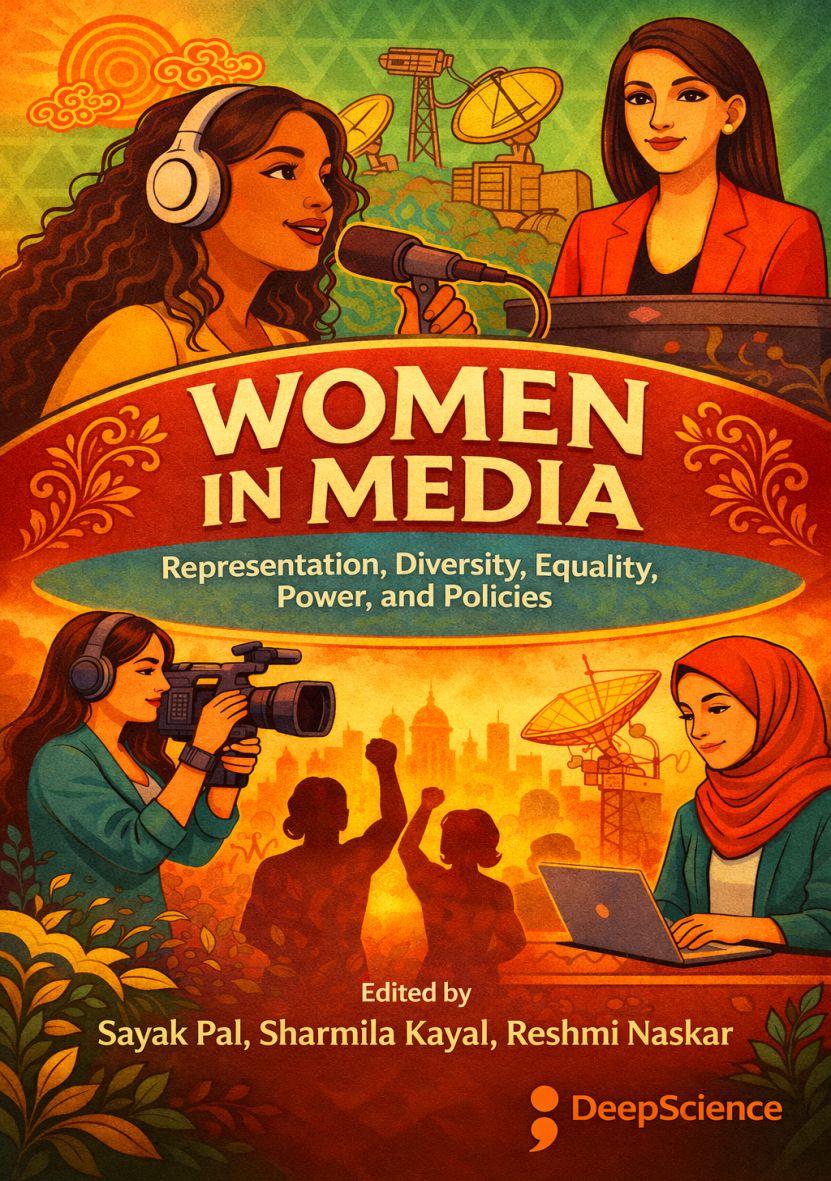
Biswas, D., Naha, D., & Roy, B. D. (2026). Unstable-Selves and More-than-Human-Worlds: A Posthuman Feminist Reading of Patriarchal Misinterpretation in Aparna Sen’s 15 Park Avenue. In S. Pal, S. . Kayal, & R. Naskar (Eds.), Women in Media: Representation, Diversity, Equality, Power, and Policies (pp. 113-125). Deep Science Publishing. https://doi.org/10.70593/978-93-7185-912-7-9
Download Citation







 WhatsApp +91 7977171947