

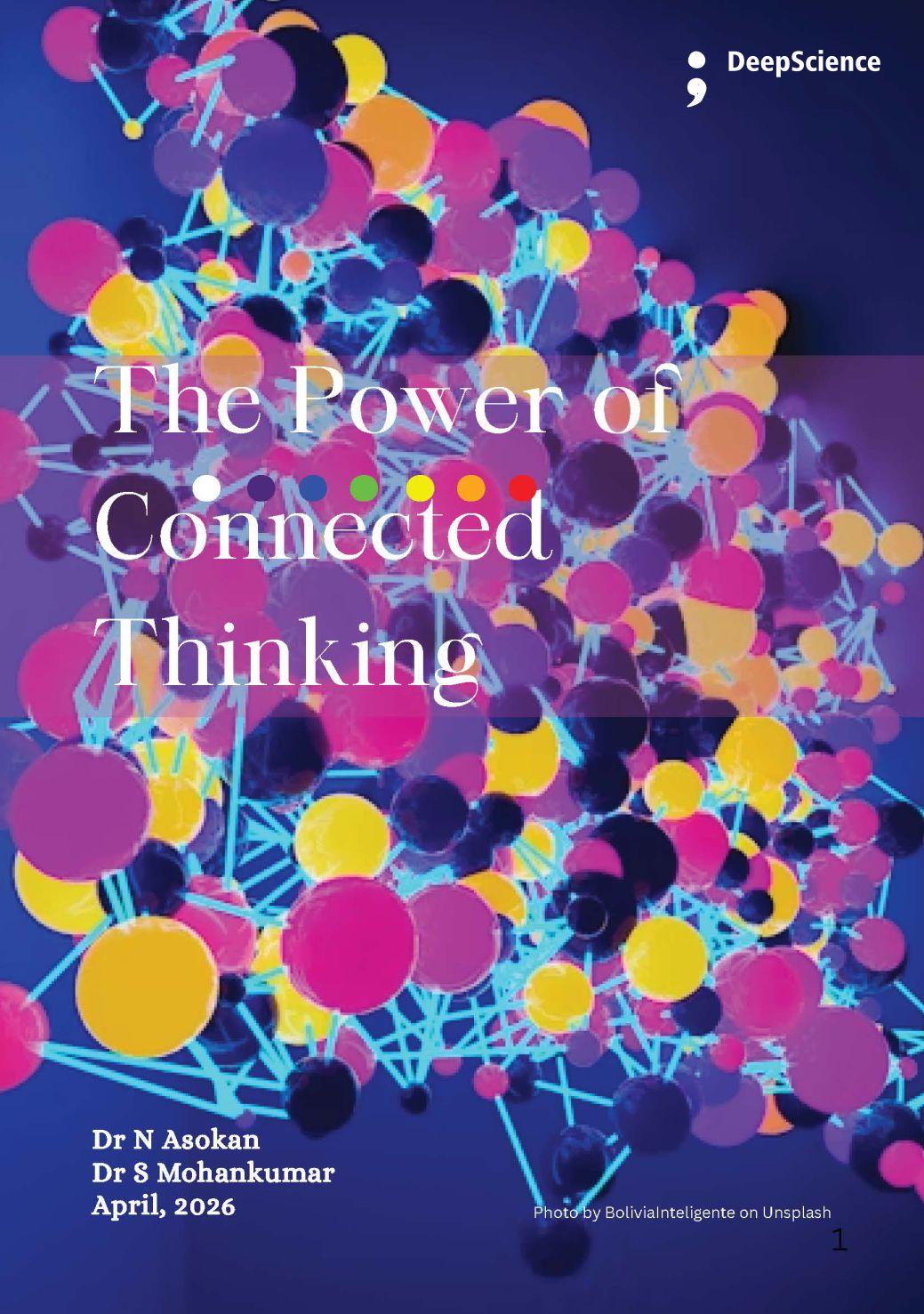
The Power of Connected Thinking
##plugins.pubIds.doi.readerDisplayName##
https://doi.org/10.70593/978-93-7185-991-2
Keywords:
Connected thinking, Systems thinking, Interdisciplinary learning, Knowledge integration, Pattern recognition, Cognitive synthesis, Critical thinkingSynopsis
In a world which is full of information, wisdom is usually in bits, in ideas which have been scattered in books, speeches, life stories and thoughts of great minds. Each book presents a point of view, each character has a point to be made, and every narrative has a lesson to be learned. But the real strength of knowledge usually lies not in individual perceptions but in the relationships which we form amongst them. It is an effort to assemble such significant fragments, and to manifest the patterns in them, in this book, The Power of Connected Thinking.
Great personalities have perceiving life, challenging assumptions, testing their ideas, and formulating principles that guide generations all over history. Their mind has been expressed in various settings: leadership, philosophy, science, management, education, creativity and personal development. As good as these insights are in isolation, they are even better when gathered well and related between fields of thought and frameworks.
The Power of Connected Thinking is a list of non-obvious concepts, ideas, principles, frameworks, stories, and experiences inspired by a broad selection of books and the thinking processes of prominent figures. This is not just to describe these works, but to condense their essence and point out the more underlying overarching patterns which connect these works with each other. Many times one principle as told in a book is echoed in a cover in another book or a story in one leader is a parallel to a teaching by a thinker in a totally different discipline.
This is why this book is a synthesis. It can encourage the reader to go past the linear reading and start grasping knowledge as a web. Through filtering information on various sources and presenting it in a systematic way, the book provokes the reader to identify connections between concepts that would have typically not been recognized. The Power of Connected Thinking is a very simple yet powerful philosophy composed of the title. Personal observations are like dots- that can be useful in the sense of being rare assets, but when joined together enhance themselves much more as well. When these dots are joined together, they disclose patterns that improve understanding, stimulate new thinking and provide a more effective decision-making. Readers can learn as they move through these pages how the various ideas come to form more comprehensive principles that can be used in day-to-day living, professional practice, and study.
The book is aimed at inquisitive minds, life long learners, educators, professionals and at everyone who is interested in the way great minds think. It promotes a sense of reflection, cross-disciplinarity as well as the tendency of deriving deeper meanings out of things that we read and experience around us.
It is also worth noting that the insights in this paper are based on numerous other authors and thought leaders whose books have impacted millions of people all over the world. Their building has remained the foundation of this book. With a blend of few ideas out of their writings and experiences, it is hoped that the reader will be able to use the selected ideas more efficiently and have a pleasant time in their answers.
Finally, the book The Power of Connected Thinking is an invitation, to read, think and always seek to find a connection between ideas. By following this habit we cultivate a knowledge which is more than information, it is understanding.
Hopefully this book can help you identify patterns where other people see bits, and to draw the lines in your personal path of learning and discovery?
Published
31 March 2026
Copyright (c) 2026 N Asokan, S Mohankumar
Details about the available publication format: E-Book
E-Book
ISBN-13 (15)
978-93-7185-991-2
How to Cite
N Asokan, & S Mohankumar. (2026). The Power of Connected Thinking. Deep Science Publishing. https://doi.org/10.70593/978-93-7185-991-2
Download Citation








 WhatsApp +91 7977171947