
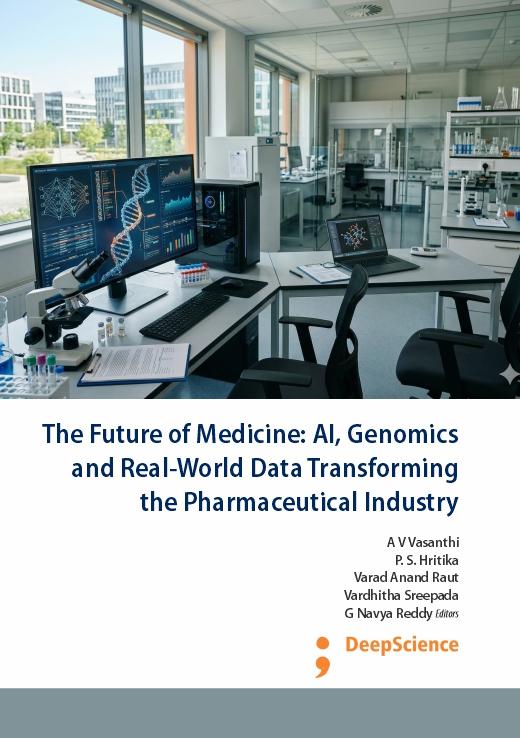
The Future of Medicine: AI, Genomics and Real-World Data Transforming the Pharmaceutical Industry
##plugins.pubIds.doi.readerDisplayName##
https://doi.org/10.70593/978-93-7185-105-3
Keywords:
Medicine, Artificial Intelligence, Genomics, Pharmaceutical Industry, Machine Learning, Personalized Medicine, HealthcareSynopsis
Pharmaceutical industry development has been transformed drastically since the days of the traditional apothecaries to a highly advanced research based industry which is dominated by synthetic chemistry, biotechnology industry and mass production. It is a historical development of the industry looking at the main milestones which included the emergence of synthetic drugs, antibiotics, and recombinant technologies as well as development of strict regulatory environments. Even in the wake of incredible advancements, classical drug development has been marred by expensive prices, long time and worryingly high failure rates, significantly because of low translatability between preclinical models and humans, inadequate patient stratification, and a one-size-fits-all paradigm.
The chapter looks at the advent of digital health technologies, such as wearables, telemedicine, AI-driven diagnostics, and decentralized trials, as potential enabling factors of change. It offers an in-depth summary of the convergence of Artificial Intelligence (AI), genomics, and Real-World Data (RWD) which can be used in a synergistic manner and are changing target identification and their selection, drug design, clinical development, and even the generation of post-approval evidence. Such data-driven methods hold promise to be more precise, efficient, and more individualized in medicine.
The significance of this change to a data driven form of healthcare is that it will help reduce attrition rates, increase innovation, and better patient outcomes and provide the opportunity to deliver care based on value. But to achieve the benefits, it is necessary to address the endemic issues of data quality, interoperability, privacy, ethics, bias, and fair access, especially in developing economies such as India. This chapter lays the groundwork to appreciate the recent transitional stage of the industry as it advances towards predictive, preventative, participatory and personalized (P4) medicine.
References
Fleming N. How artificial intelligence is changing drug discovery [Internet]. 2018 (updated 2025). Available from: https://www.nature.com/articles/d41586-018-05267-x
Haque A, et al. Integration of multi-omics data and AI for precision medicine [Internet]. 2025. Available from: https://pmc.ncbi.nlm.nih.gov/articles/PMC11234567/
Hamburg MA, Collins FS. The path to personalized medicine [Internet]. 2010 (updated review 2024). Available from: https://www.nejm.org/doi/full/10.1056/NEJMp1011024
Voigtlaender S, et al. Digital twins in healthcare: current applications and future outlook [Internet]. 2025. Available from: https://www.nature.com/articles/s41573-025-00987-2
Digital Therapeutics Alliance. Digital Therapeutics: Combining Technology and Evidence-Based Medicine [Internet]. 2024. Available from: https://dtxalliance.org/
Insilico Medicine. Digital twins and generative AI in drug development [Internet]. 2025. Available from: https://www.insilico.com/publications
World Health Organization. Digital Health and Equity in Low- and Middle-Income Countries [Internet]. 2024. Available from: https://www.who.int/publications/i/item/digital-health-equity
Downloads
Published
17 March 2026
Copyright (c) 2026 A V Vasanthi, P. S. Hritika, Varad Anand Raut, Vardhitha Sreepada, G Navya Reddy
Details about the available publication format: E-Book
E-Book
ISBN-13 (15)
978-93-7185-105-3
Details about the available publication format: Book (Paperback)
Book (Paperback)
ISBN-13 (15)
978-93-7185-184-8
How to Cite
A V Vasanthi, P. S. Hritika, Raut, V. A. ., Sreepada, V. ., & Reddy, G. N. . (Eds.). (2026). The Future of Medicine: AI, Genomics and Real-World Data Transforming the Pharmaceutical Industry. Deep Science Publishing. https://doi.org/10.70593/978-93-7185-105-3
Download Citation






 WhatsApp +91 7977171947