

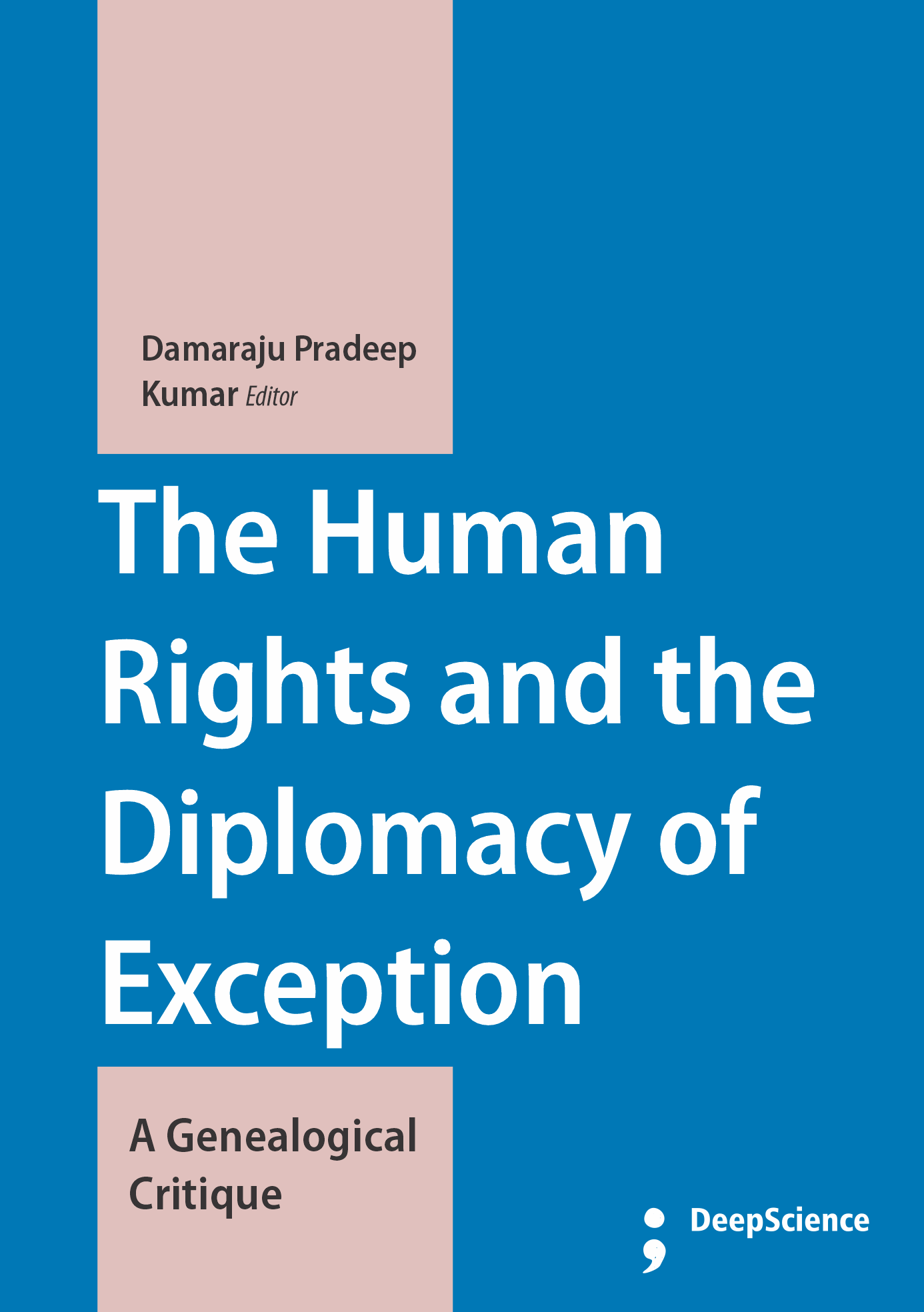
The Human Rights and the Diplomacy of Exception: A Genealogical Critique
##plugins.pubIds.doi.readerDisplayName##
https://doi.org/10.70593/978-93-7185-097-1
Keywords:
Human Rights, Diplomacy, Exception, Sovereign Exceptions, Warfare, Humanitarian Law, Illegal immigrationSynopsis
It is an exclusive honor to present this timely text, an impressive piece,“The Human Rights and the Diplomacy of Exception: A Genealogical Critique. At a time of worldwide governance in tricky tussles between the power and responsibility, this book provides a sharp enquiry into the historical paths and institution practices that operate as rights are claimed, bargained and sometimes halted. Its philosophical aspiration is equalized with a practitioner and those, who can distinguish between the bets: lives, sovereignties and legitimacy of international orders.
The significance and International Systems.
The volume comes at a point when the world promises in the forms of the international and universal commitments expressed by the United Nations and the Universal Declaration of Human Rights are open to a new criterion. The grammar of obligations has been extended by multilateral instruments, special procedures, and treaty bodies and regional mechanisms; but their functioning has been mediated by state interests, strategic rationales and exceptionalist logic. The author skillfully follows the dynamics between the normative declarations, treaty undertakings and institutional directives and diplomatic practice, and this provides an insight into the circumstances by which normative assertions become protection and in other cases, just aspirational.
Genealogies of Practice
The genealogical approach toward the book is a key strength of the book. The work depicts how the responses to the contemporary setting were generated by the previous, more intricate arrangements of power and professionalism by mapping the lineages of ideology, structuring of the institution and state practices. This historical sensibility throws light on recurrent patterns: the localisation of humanitarian interest, the grammar of protection (which is always bureaucratic), and the discrimination in the operationalisation of values in the diplomatic spaces. The genealogy explains why some populations are attended to and given resources at the expense of having the others taken to administration in limbo.
Imperative of Sovereignty and Diplomatic Imperative.
The conflict between the sovereign prerogatives and transnational obligations runs through the analysis. The book convincingly shows how sovereignty does not just exist as a juridical shell; rather, it is negotiated as a result of a diplomatic give and take as well as normative argument. States invoke powers and need in order to invoke exceptions and conversely international actors use rights-based speech in order to put a limit or to reform practices. The diplomacy that emanates is mostly transactional being dictated by the issue of security, development needs and political affiliations.
Indian Perspective
The work, and its interpretation in particular, resonates especially with the readers in India and South Asia. It places national jurisprudence and national policy decisions in transnational streams, as national discussions of rights, citizenship and migration are reflected and impacted by international discourse. The book wrestles with the governance structures of the region, migratory patterns and political processes, which have an implication on issues of acknowledgement and security. Its repercussions are priceless to the scholars, policymakers and practitioners who would like to make constitutional commitments meet the demands of the outside world to which India is a leading regional player.
Vulnerable Populations, Stateless Persons and Refugees.
Dis displaced and stateless persons are punished and treated with this compassion. The author analyses the influence of the diplomatic bargaining, political considerations and administrative typologies in the realities of these populations. By organizing the documentation, and by critically evaluating the policy practice, the book reveals such failures between normative promises, and material results: protection regimes based on discretionary administrative practices, legal limbos that increase the vulnerability, and political narratives that prefers structural reasons.
Actors and Declarations of an Institution.
The analysis, in addition to the UN and the UDHR, is involved with an array of bodies and instruments -regional commissions, treaty-monitoring bodies, special rapporteurs and civil society networks-which have a combined effect that is known as the architecture of accountability. The book assesses the effectiveness of declarations and soft-law instruments as morally assertive as well as diplomatic instruments, which occasionally spur reform but occasionally serve as a enablement of action or forbearance. This subtle evaluation is useful in helping the readers to figure out where significant change can be planted.
The Human Rights and the Diplomacy of Exception: A Genealogical Critique gives a roadmap as well as an opportunity of critique. It poses pressures on diplomats, jurists and the civil society to consider the genealogies which generate exceptions and question that which the institutions incentivize. The book has convinced me as a practitioner and jurist that lasting change must be achieved by a different form of diplomacy that builds institutional strength and demands accountability, that gives voice to the majority affected, and balances all three elements in pursuing lasting change.
This book is a valuable companion in the complex world of an international order that is marked with contestation. It makes its readers prepared to see the paradoxes of contemporary forms of governance and introduce reforms, which are juridically valid, politically realistic and ethically based. I believe that the Human Rights and the Diplomacy of Exception: A Genealogical Critique will become a point of reference to all of us keen to reform diplomatic practice with the demands of justice and protection.
References
Agamben, G. (1998). Homo sacer: Sovereign power and bare life (D. Heller-Roazen, Trans.). Stanford University Press. https://doi.org/10.1515/9780804764025
Agamben, G. (2005). State of exception (K. Attell, Trans.). University of Chicago Press. https://doi.org/10.7208/chicago/9780226009261.001.0001
Agamben, G. (1999). Remnants of Auschwitz: The witness and the archive (D. Heller-Roazen, Trans.). Zone Books. https://doi.org/10.2307/j.ctvjnrv06
Agamben, G. (2011). The kingdom and the glory: For a theological genealogy of economy and government (L. Chiesa & M. Mandarini, Trans.). Stanford University Press. https://doi.org/10.1515/9780804771535
Agamben, G. (2013). The highest poverty: Monastic rules and form-of-life. Stanford University Press. https://doi.org/10.1515/9780804786744
Agamben, G. (2016). The use of bodies. Stanford University Press. https://doi.org/10.1515/9780804799980
Arendt, H. (1973). The origins of totalitarianism. Harcourt Brace. https://doi.org/10.4324/9781315838564
Arendt, H. (1958). The human condition. University of Chicago Press. https://doi.org/10.7208/chicago/9780226924571.001.0001
Arendt, H. (1968). Imperialism. Harcourt Brace. https://doi.org/10.4324/9781315086484
Balibar, E. (2004). We, the people of Europe? Reflections on transnational citizenship. Princeton University Press. https://doi.org/10.1515/9781400825820
Bauman, Z. (2004). Wasted lives: Modernity and its outcasts. Polity Press. https://doi.org/10.4324/9781315251783
Benhabib, S. (2004). The rights of others: Aliens, residents, and citizens. Cambridge University Press. https://doi.org/10.1017/CBO9780511790799
Bhambra, G. K. (2014). Connected sociologies. Bloomsbury Academic. https://doi.org/10.5040/9781472544377
Butler, J. (2004). Precarious life: The powers of mourning and violence. Verso. https://doi.org/10.4324/9781315882536
Butler, J. (2009). Frames of war: When is life grievable? Verso. https://doi.org/10.4324/9781315636313
Chimni, B. S. (2009). The birth of a “discipline”: From refugee to forced migration studies. Journal of Refugee Studies, 22(1), 11–29. https://doi.org/10.1093/jrs/fen051
Chimni, B. S. (2017). International refugee law: A reader. Sage Publications. https://doi.org/10.4135/9789353886141
Derrida, J. (2001). On cosmopolitanism and forgiveness. Routledge. https://doi.org/10.4324/9780203994535
Douzinas, C. (2000). The end of human rights. Hart Publishing. https://doi.org/10.4324/9781315095806
Fassin, D. (2011). Humanitarian reason: A moral history of the present. University of California Press. https://doi.org/10.1525/9780520950481
Foucault, M. (1977). Discipline and punish: The birth of the prison (A. Sheridan, Trans.). Pantheon Books. https://doi.org/10.4324/9780429492580
Foucault, M. (1978). The history of sexuality: Volume I: An introduction (R. Hurley, Trans.). Pantheon Books. https://doi.org/10.4324/9781315831534
Foucault, M. (2007). Security, territory, population: Lectures at the Collège de France, 1977–1978. Palgrave Macmillan. https://doi.org/10.1057/9780230245075
Foucault, M. (2008). The birth of biopolitics: Lectures at the Collège de France, 1978–1979. Palgrave Macmillan. https://doi.org/10.1057/9780230594180
Goodwin-Gill, G. S., & McAdam, J. (2021). The refugee in international law (4th ed.). Oxford University Press. https://doi.org/10.1093/he/9780198808565.001.0001
Guild, E. (2009). Security and migration in the 21st century. Polity Press. https://doi.org/10.4324/9781315570606
Haddad, E. (2008). The refugee in international society: Between sovereigns. Cambridge University Press. https://doi.org/10.1017/CBO9780511491290
Harvey, D. (2005). A brief history of neoliberalism. Oxford University Press. https://doi.org/10.1093/oso/9780199283279.001.0001
Mbembe, A. (2019). Necropolitics. Duke University Press. https://doi.org/10.1215/9781478007227
Malkki, L. H. (1995). Purity and exile: Violence, memory, and national cosmology among Hutu refugees in Tanzania. University of Chicago Press. https://doi.org/10.7208/chicago/9780226190969.001.0001
Mezzadra, S., & Neilson, B. (2013). Border as method, or, the multiplication of labor. Duke University Press. https://doi.org/10.1215/9780822377542
Moyn, S. (2010). The last utopia: Human rights in history. Harvard University Press. https://doi.org/10.4159/9780674055186
Nyers, P. (2006). Rethinking refugees: Beyond states of emergency. Routledge. https://doi.org/10.4324/9780203964538
Rajaram, P. K., & Grundy-Warr, C. (2007). Borderscapes: Hidden geographies and politics at territory’s edge. University of Minnesota Press. https://doi.org/10.5749/minnesota/9780816649891.001.0001
Rancière, J. (2004). Disagreement: Politics and philosophy. University of Minnesota Press. https://doi.org/10.5749/minnesota/9780816628438.001.0001
Sassen, S. (2014). Expulsions: Brutality and complexity in the global economy. Harvard University Press. https://doi.org/10.4159/9780674369818
Schmitt, C. (2005). Political theology: Four chapters on the concept of sovereignty (G. Schwab, Trans.). University of Chicago Press. https://doi.org/10.7208/chicago/9780226738895.001.0001
Schmitt, C. (2008). The concept of the political (G. Schwab, Trans.). University of Chicago Press. https://doi.org/10.7208/chicago/9780226738864.001.0001
Shachar, A. (2009). The birthright lottery: Citizenship and global inequality. Harvard University Press. https://doi.org/10.4159/9780674054783
Soguk, N. (1999). States and strangers: Refugees and displacements of statecraft. University of Minnesota Press. https://doi.org/10.5749/minnesota/9780816631315.001.0001
Soysal, Y. N. (1994). Limits of citizenship: Migrants and postnational membership in Europe. University of Chicago Press. https://doi.org/10.7208/chicago/9780226768397.001.0001
Ticktin, M. (2011). Casualties of care: Immigration and the politics of humanitarianism in France. University of California Press. https://doi.org/10.1525/9780520950535
Turner, B. S. (2006). Vulnerability and human rights. Pennsylvania State University Press. https://doi.org/10.1515/9780271043326
Walters, W. (2002). Deportation, expulsion, and the international police of aliens. Citizenship Studies, 6(3), 265–292. https://doi.org/10.1080/1362102022000011612
Weber, L., & Bowling, B. (2008). Valient beggars and global vagabonds: Select, eject, immobilize. Theoretical Criminology, 12(3), 355–375. https://doi.org/10.1177/1362480608090258
Zedner, L. (2005). Securing liberty in the face of terror. Journal of Law and Society, 32(4), 507–533. https://doi.org/10.1111/j.1467-6478.2005.00336.x
Žižek, S. (2002). Welcome to the desert of the real. Verso. https://doi.org/10.4324/9781315024189
Aradau, C., & Van Munster, R. (2007). Governing terrorism through risk. European Journal of International Relations, 13(1), 89–115. https://doi.org/10.1177/1354066107074299
Bigo, D. (2002). Security and immigration: Toward a critique of the governmentality of unease. Alternatives, 27(1), 63–92. https://doi.org/10.1177/03043754020270S105
De Genova, N. (2013). Spectacles of migrant “illegality”. Ethnic and Racial Studies, 36(7), 1180–1198. https://doi.org/10.1080/01419870.2013.783710
Fassin, D., & Pandolfi, M. (2010). Contemporary states of emergency. Zone Books. https://doi.org/10.2307/j.ctvjnrv2m
Gregory, D. (2004). The colonial present. Blackwell Publishing. https://doi.org/10.1002/9780470755761
Mamdani, M. (2001). When victims become killers. Princeton University Press. https://doi.org/10.1515/9781400840786
Nail, T. (2016). Theory of the border. Oxford University Press. https://doi.org/10.1093/acprof:oso/9780190618650.001.0001
Puar, J. K. (2007). Terrorist assemblages: Homonationalism in queer times. Duke University Press. https://doi.org/10.1215/9780822389286
Said, E. W. (1978). Orientalism. Pantheon Books. https://doi.org/10.4324/9781003096627
Sassen, S. (2006). Territory, authority, rights: From medieval to global assemblages. Princeton University Press. https://doi.org/10.1515/9781400847488
Scott, J. C. (1998). Seeing like a state. Yale University Press. https://doi.org/10.12987/9780300128789
Taylor, D. (2020). Rights in crisis: Human rights in a time of uncertainty. Oxford University Press. https://doi.org/10.1093/oso/9780190096793.001.0001
Torpey, J. (2000). The invention of the passport. Cambridge University Press. https://doi.org/10.1017/CBO9780511759024
Walker, R. B. J. (1993). Inside/outside: International relations as political theory. Cambridge University Press. https://doi.org/10.1017/CBO9780511559150
Weheliye, A. G. (2014). Habeas viscus: Racializing assemblages, biopolitics, and Black feminist theories of the human. Duke University Press. https://doi.org/10.1215/9780822376491
Wendy, B. (2015). Undoing the demos: Neoliberalism’s stealth revolution. Zone Books. https://doi.org/10.2307/j.ctt17kk9p8
Young, I. M. (2003). Inclusion and democracy. Oxford University Press. https://doi.org/10.1093/0198297556.001.0001
Zembylas, M. (2010). Agamben’s theory of biopower and immigrants/refugees/asylum seekers. Educational Philosophy and Theory, 42(1), 31–45. https://doi.org/10.1111/j.1469-5812.2009.00642.x
Downloads
Published
17 June 2026
Copyright (c) 2026 Damaraju Pradeep Kumar
Details about the available publication format: E-Book
E-Book
ISBN-13 (15)
978-93-7185-097-1
Details about the available publication format: Book (Paperback)
Book (Paperback)
ISBN-13 (15)
978-93-7185-137-4
How to Cite
Kumar, D. P. . (2026). The Human Rights and the Diplomacy of Exception: A Genealogical Critique. Deep Science Publishing. https://doi.org/10.70593/978-93-7185-097-1
Download Citation









 WhatsApp +91 7977171947