

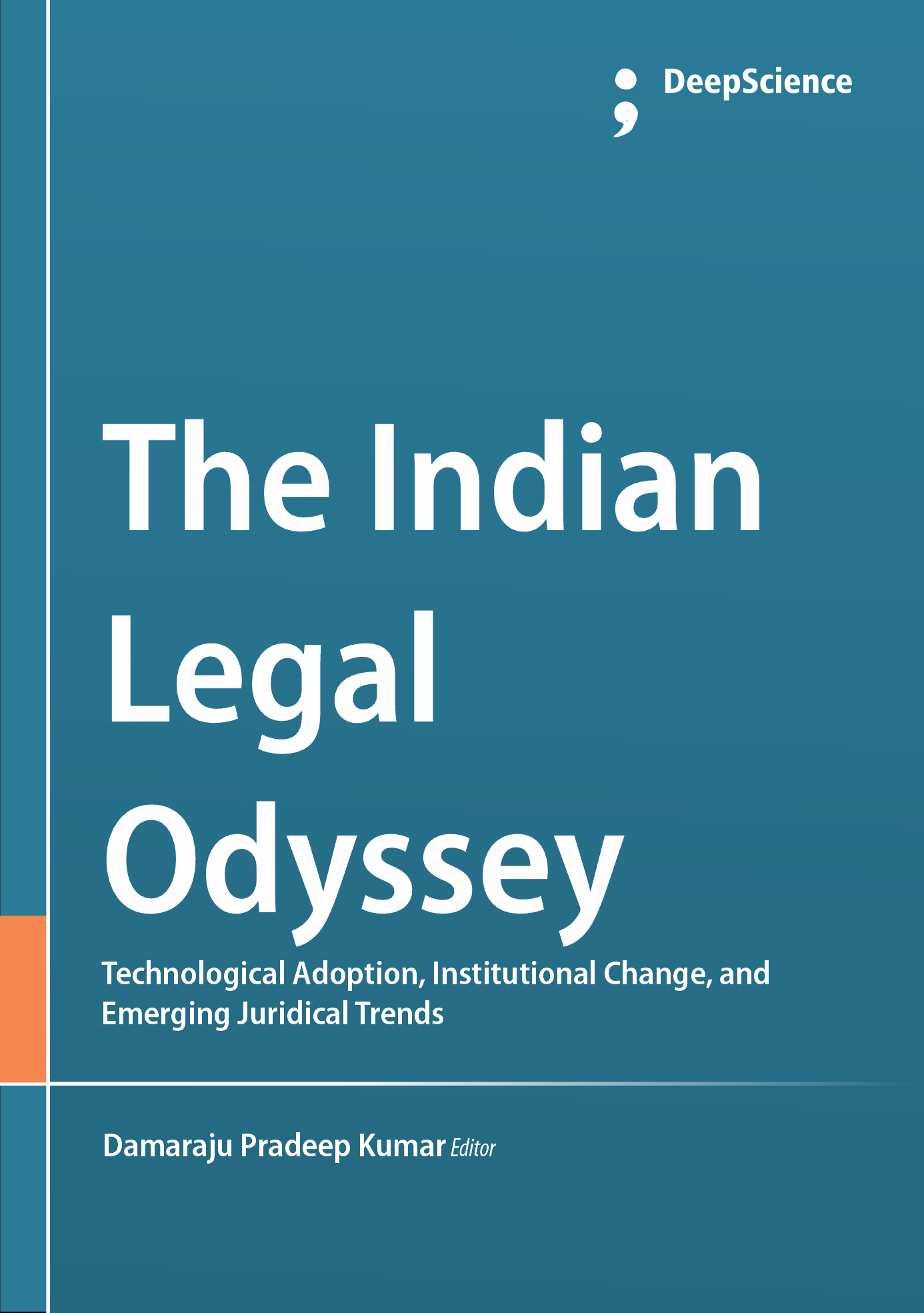
The Indian Legal Odyssey: Technological Adoption, Institutional Change, and Emerging Juridical Trends
##plugins.pubIds.doi.readerDisplayName##
https://doi.org/10.70593/978-93-7185-543-3
Keywords:
Technological Adoption , Law, Institutional Change, Governance, Bail, Corporate Governance, FintechSynopsis
This book provides an easy to follow and engaging journey of how law and justice throughout India are redefining by technology and institutions. Dr. Damaraju Pradeep Kumar is an authority, a scholar of doctrine and practice, although he prefers simple, easily readable language, to have policy-makers, practitioners, students, and other interested citizens keep up with complicated changes without stumbling over the complex vocabulary. The book bridges the decisions of courts, the administrative reforms and on-the-ground technological systems to demonstrate how each influences access of ordinary people to justice.
Rather than addressing technology as an abstract innovation, in early chapters, technology is seen as a practical force that alters the manner in which legal work is done and to whom. E-filing systems, digital registries, AI, and surveillance technologies are explained in such a way that explains their offers- quicker processes, increased scale- as well as dangers- unseen biases, loss of privacy, and new disparities. Through the example of daily life and observations of comparison, Dr. Damaraju explains where the digital tools have made the justice process fairer and where the new issues have emerged that need to be tackled by law-makers and judges.
The next area of change in the book is institutional change. It describes the way courts, government agencies and the legal profession change and evolve as the old rules encounter the new realities. The author reads significant judgments and reform projects with a judgment about practical implications: how to cope with large caseloads and how to streamline processes in tribal and how to train lawyers and law schools to train the next generation of lawyers. The chapters do not just focus on technical exposition but also display human, and organization modifications that are eminent in reform success.
Speaking of judicial trends, Dr. Damaraju singles out the trends that are pertinent to the daily life. Courts adopt a management stance occasionally- making processes leaner and the institutions work towards optimal operation. They intervene to defend rights occasionally, particularly where the technology brings about privacy or speech threats. The author strikes a balance between applause over judicial creativity, as well as consideration of boundaries; the courts cannot become the sole channel of reform, and the good intentions of intervening to create positive changes may yield unpredicted results when the institutional capabilities are insufficient.
A lasting, tense, forward-moving focus on the things that matter in the end closes the book, that technology is mighty, but will not alone brings justice. Getting anywhere requires institutions and individuals to make purposeful decisions: to design open algorithms, reimagine processes to put dignity and access at the center and to create effective, responsible oversight. It is as significant to train judges, lawyers and administrators on the significance of learning the ins and outs of the socio-technical systems as it is to obtain tools. The general appeal of these pages is to couple technical innovation with deliberation under democracy and institutional nurturing: as policymakers develop regulations, as administrators redesign processes, as the legal profession accepts moral responsibility and develops technical abilities, the system of justice can be made more accessible and more fair. The change of a digital kind is without such attempts community will reinforce old inequalities on both sides; when it is pursued in good faith, it will give way to a legal system that promotes the common interest in a better system of laws and benefits all citizens. This focus on human stewardship- on competence coupled with values- provides a useful guide to readers who desire technology assistance and not obstructive way in seeking justice.
There is another filament threading silently through the book, and giving it a rich flavor of practice: an insistence on everlasting learning and on unbiased assessment. Dr. Damaraju encourages institutions to consider iterative methods; pilot projects, impact assessment, and feedback loops, to enable reforms to be tested, remedied, and ramped in a responsible manner. Participatory design is also important to him (participation of marginalised communities, front-line court workers and civilsociety actors in digital-system design) so that digital systems can be designed to address real needs. This experimental and inclusive devotion transforms abstract policy prescriptions into practice and provides the reader with some specific avenues of action on the reform agenda, both locally, institutionally, and nationally.
References
Balkin, J. M. (2016). The path of robotics law. California Law Review, 104(1), 45–60. https://doi.org/10.15779/Z38BG31
Bennett Moses, L. (2013). How to think about law, regulation and technology. Law, Innovation and Technology, 5(1), 1–20. https://doi.org/10.5235/17579961.5.1.1
Brownsword, R. (2008). Rights, regulation, and the technological revolution. Oxford University Press. https://doi.org/10.1093/acprof:oso/9780199276802.001.0001
Citron, D. K. (2014). Hate crimes in cyberspace. Harvard University Press. https://doi.org/10.4159/harvard.9780674737729
Cohen, J. E. (2019). Between truth and power: The legal constructions of informational capitalism. Oxford University Press. https://doi.org/10.1093/oso/9780190246699.001.0001
DeNardis, L. (2014). The global war for internet governance. Yale University Press. https://doi.org/10.12987/yale/9780300181353.001.0001
Easterbrook, F. H. (1996). Cyberspace and the law of the horse. University of Chicago Legal Forum, 1996(1), 207–216. https://doi.org/10.2139/ssrn.970610
Floridi, L. (2014). The fourth revolution: How the infosphere is reshaping human reality. Oxford University Press. https://doi.org/10.1093/acprof:oso/9780199606722.001.0001
Floridi, L., & Cowls, J. (2019). A unified framework of five principles for AI in society. Harvard Data Science Review. https://doi.org/10.1162/99608f92.8cd550d1
Fukuyama, F. (2022). Liberalism and its discontents. Farrar, Straus and Giroux. https://doi.org/10.2307/j.ctv2t4d7h2
Ginsburg, T., & Huq, A. Z. (2018). How to save a constitutional democracy. University of Chicago Press. https://doi.org/10.7208/chicago/9780226564384.001.0001
Hildebrandt, M. (2015). Smart technologies and the end(s) of law. Edward Elgar Publishing. https://doi.org/10.4337/9781782548764
Kuner, C. (2007). European data protection law. Oxford University Press. https://doi.org/10.1093/acprof:oso/9780199283855.001.0001
Lessig, L. (2006). Code version 2.0. Basic Books. https://doi.org/10.2139/ssrn.2247473
Mayer-Schönberger, V., & Cukier, K. (2013). Big data. Houghton Mifflin Harcourt. https://doi.org/10.2307/j.ctt6wq7d7
Nissenbaum, H. (2010). Privacy in context. Stanford University Press. https://doi.org/10.1515/9780804772897
Pasquale, F. (2015). The black box society. Harvard University Press. https://doi.org/10.4159/9780674736067
Richards, N. M. (2015). Intellectual privacy. Oxford University Press. https://doi.org/10.1093/acprof:oso/9780199946149.001.0001
Roßnagel, A. (2021). Artificial intelligence and data protection. Computer Law & Security Review, 41, 105567. https://doi.org/10.1016/j.clsr.2021.105567
Sahoo, M. S. (2021). Insolvency and bankruptcy reforms in India. Indian Journal of Law and Economics, 12(2), 1–18. https://doi.org/10.1007/s41027-021-00309-8
Schwab, K. (2017). The fourth industrial revolution. Currency. https://doi.org/10.4324/9781003086198
Solove, D. J. (2021). Understanding privacy. Harvard University Press. https://doi.org/10.4159/9780674240052
Srivastava, S. C. (2022). Digital constitutionalism in India. Journal of Constitutional Law and Governance, 8(1), 44–62. https://doi.org/10.1007/s42979-022-01015-y
Sunstein, C. R. (2018). #Republic: Divided democracy in the age of social media. Princeton University Press. https://doi.org/10.1515/9781400888913
Suskind, R. (2019). Online courts and the future of justice. Oxford University Press. https://doi.org/10.1093/oso/9780198838360.001.0001
Suskind, R. (2023). How to think about AI. Oxford University Press. https://doi.org/10.1093/oso/9780192848495.001.0001
Teubner, G. (2012). Constitutional fragments. Oxford University Press. https://doi.org/10.1093/acprof:oso/9780199644670.001.0001
Tushnet, M. (2020). Advanced introduction to comparative constitutional law. Edward Elgar Publishing. https://doi.org/10.4337/9781789906918
Veale, M., & Borgesius, F. Z. (2021). Demystifying the Draft EU AI Act. Computer Law Review International, 22(4), 97–112. https://doi.org/10.9785/cri-2021-220402
Wachter, S., Mittelstadt, B., & Floridi, L. (2017). Transparent, explainable, and accountable AI. Science Robotics, 2(6). https://doi.org/10.1126/scirobotics.aan6080
Weber, R. H. (2010). Internet of things – New security and privacy challenges. Computer Law & Security Review, 26(1), 23–30. https://doi.org/10.1016/j.clsr.2009.11.008
Westin, A. F. (1967). Privacy and freedom. Atheneum. https://doi.org/10.2307/2576040
Zuboff, S. (2019). The age of surveillance capitalism. PublicAffairs. https://doi.org/10.1080/02673037.2019.1644285
Bostrom, N. (2014). Superintelligence: Paths, dangers, strategies. Oxford University Press. https://doi.org/10.1093/acprof:oso/9780199678118.001.0001
Rawls, J. (1999). A theory of justice (Revised ed.). Harvard University Press. https://doi.org/10.2307/j.ctvjf9z6v
Alexy, R. (2002). A theory of constitutional rights. Oxford University Press. https://doi.org/10.1093/acprof:oso/9780198258212.001.0001
Dworkin, R. (1986). Law’s empire. Harvard University Press. https://doi.org/10.2307/j.ctvjghv1r
Habermas, J. (1996). Between facts and norms. MIT Press. https://doi.org/10.7551/mitpress/1564.001.0001
Sen, A. (2009). The idea of justice. Harvard University Press. https://doi.org/10.4159/9780674054574
Tribe, L. H. (1988). Constitutional choices. Harvard University Press. https://doi.org/10.4159/9780674044452
Downloads
Published
20 June 2026
Copyright (c) 2026 Damaraju Pradeep Kumar
Details about the available publication format: E-Book
E-Book
ISBN-13 (15)
978-93-7185-543-3
Details about the available publication format: Book (Paperback)
Book (Paperback)
ISBN-13 (15)
978-93-7185-902-8
How to Cite
Kumar, D. P. . (2026). The Indian Legal Odyssey: Technological Adoption, Institutional Change, and Emerging Juridical Trends. Deep Science Publishing. https://doi.org/10.70593/978-93-7185-543-3
Download Citation








 WhatsApp +91 7977171947