

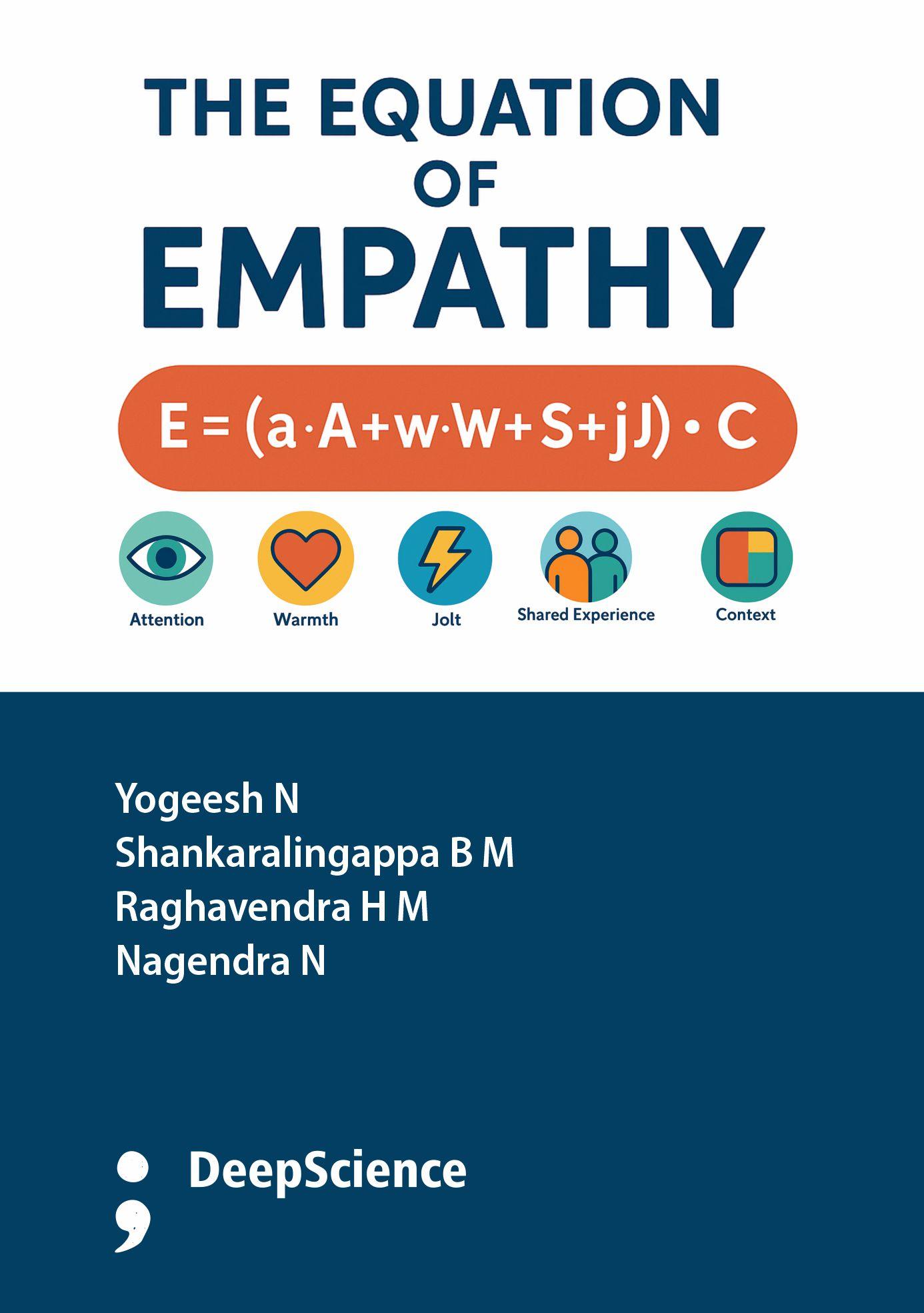
The Equation of Empathy
##plugins.pubIds.doi.readerDisplayName##
https://doi.org/10.70593/978-93-7185-444-3
Keywords:
Empathy , Equation, Small Acts, Balancing Differences, Probability of Connection, Friendship, Body LanguageSynopsis
Why Empathy Requires a new Language.
Empathy is one of the highly demanded qualities in our hyperconnected, fast-paced world but has too often been oversimplified into general advice or a set of best practices. We do not have the vocabulary to share out what really occurs when we listen, comfort or surprise a person, we cannot gauge our improvement or contrast strides in an academic way. This book presents a new paradigm the mathematical language of empathy. Transducing attention, warmth, little gestures, fortuitous circumstances, mentoring contributions, geometry of body languages, relationship dynamics, network topologies and emotional boundaries into specific models equation, sums, probabilities, functions, forms, rates, graphs, and asymptotes, we acquire the means of building, maintaining, and tracking connection with clarity and assurance.
The Use of the Stories, Examples and Exercises.
The book starts with a lively story in every chapter that makes the math come to life real world vignettes to which you can connect and reconnect. After reading the story, you will have step wise derivations of the underlying model, worked examples with real numbers and hands on practice or mini-projects in which you record data, draw wireframes, perform simple mathematical calculators or just draw your own networks. The important concepts are presented in the form of infographics and available figures that allow you to see the main points at once, and practice problems help you learn. You can read through to get a holistic structure or you can go straight to the chapter that offers you the lens that is needed at the given moment whether that is to fine tune your bedside manner, repair a strained relationship within the team, or set up a community campaign. Through reading the stories, practicing the formulas and trying the exercises, you not only will have the empathy on a deeper level but also will develop it as something that can be measured and improved in every area of your life.
Moreover, this book is planned to expand along with you. Think of each model as a component kit you can go into individual chapters to when you have particular issues to tackle and go back to previous chapters as you gain more insight. Then create your own book or digital journal in which you jot down your own data be it daily empathy scores, number of micros acts, network diagrams and check into it often. With time, you will create your own customized playbook of patterns and interventions that are most effective in your unique style and context, and you can explore relationships not by trial and error, but with purposefulness, understanding and the certainty that comes with a language created with empathy in mind.
References
Apostol, T. M. (1967). Calculus, Vol. 1: One Variable Calculus, with an Introduction to Linear Algebra. Wiley.
Barabási, A.-L. (2016). Network Science. Cambridge University Press.
Blitzstein, J., & Hwang, J. (2019). Introduction to Probability (2nd ed.). CRC Press.
Boyd, S., & Vandenberghe, L. (2004). Convex Optimization. Cambridge University Press.
Christakis, N. A., & Fowler, J. H. (2009). Connected: The Surprising Power of Our Social Networks and How They Shape Our Lives. Little, Brown and Company.
Cialdini, R. B. (2006). Influence: The Psychology of Persuasion. Harper Business.
Diestel, R. (2017). Graph Theory (5th ed.). Springer.
Figley, C. R. (2002). Compassion Fatigue: Psychotherapists’ Chronic Lack of Self Care. Brunner Routledge.
Frontiers in Psychology. (2019). Measuring empathy in humans: A critical review of current methods. Frontiers in Psychology, 10, Article 2205.
Granovetter, M. S. (1973). The Strength of Weak Ties. American Journal of Sociology, 78(6), 1360–1380.
Jones, C., & Smith, L. (2017). Prospective functions of mentoring: A meta analysis. Journal of Vocational Behavior, 98, 124–142.
Klir, G. J., & Yuan, B. (1995). Fuzzy Sets and Fuzzy Logic: Theory and Applications. Prentice Hall.
Krug, S. (2000). Don’t Make Me Think: A Common Sense Approach to Web Usability. New Riders.
Lay, D. C. (2015). Linear Algebra and Its Applications (5th ed.). Pearson.
McLaren, K. (2013). The Art of Empathy: A Complete Guide to Life’s Most Essential Skill. Sounds True.
Newman, M. E. J. (2018). Networks: An Introduction. Oxford University Press.
Pentland, A. (2014). Social Physics: How Good Ideas Spread—and Why They Thrive in New York, Boston, and Beyond. Penguin Press.
Rosen, K. H. (2018). Discrete Mathematics and Its Applications (8th ed.). McGraw Hill Education.
Ross, S. M. (2014). Introduction to Probability Models (11th ed.). Academic Press.
Silver, N. (2012). The Signal and the Noise: Why So Many Predictions Fail—but Some Don’t. Penguin Press.
Stewart, J. (2015). Calculus: Early Transcendentals (8th ed.). Cengage Learning.
Strang, G. (2009). Introduction to Linear Algebra (4th ed.). Wellesley Cambridge Press.
Wasserman, S., & Faust, K. (1994). Social Network Analysis: Methods and Applications. Cambridge University Press.
Zadeh, L. A. (1965). “Fuzzy Sets.” Information and Control, 8(3), 338–353.
Downloads
Published
22 June 2026
Copyright (c) 2026 Yogeesh N, Shankaralingappa B M, Raghavendra H M, Nagendra N
Details about the available publication format: E-Book
E-Book
ISBN-13 (15)
978-93-7185-444-3
Details about the available publication format: Book (Paperback)
Book (Paperback)
ISBN-13 (15)
978-93-7185-448-1
How to Cite
Yogeesh N, Shankaralingappa B M, Raghavendra H M, & Nagendra N. (2026). The Equation of Empathy. Deep Science Publishing. https://doi.org/10.70593/978-93-7185-444-3
Download Citation










 WhatsApp +91 7977171947