

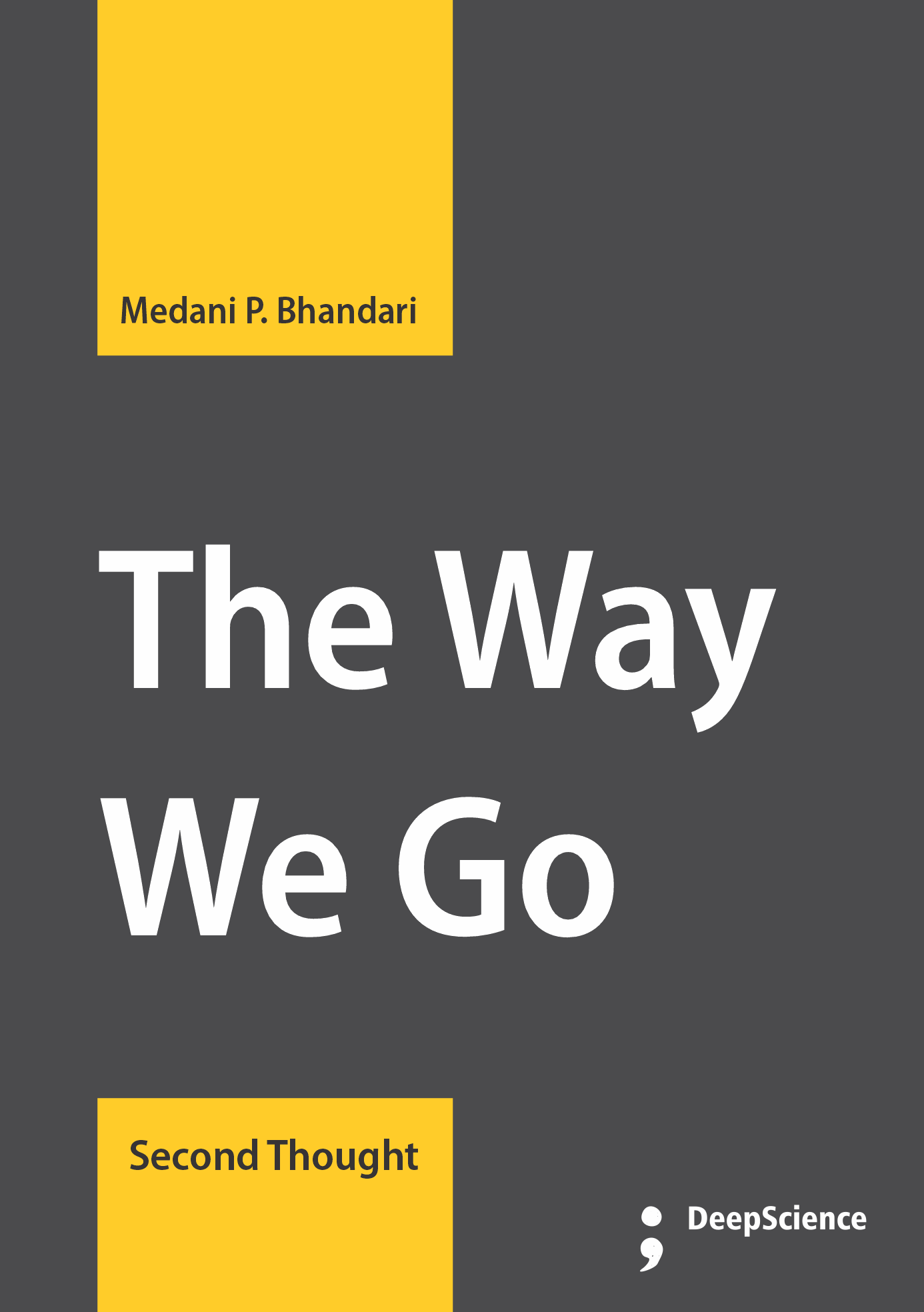
The Way We Go, Second Thought
##plugins.pubIds.doi.readerDisplayName##
https://doi.org/10.70593/978-93-7185-439-9
Keywords:
Human Life, Human Spirit, Relationships, Family and Community Bonds, Humanity, Diversity, NatureSynopsis
The Way We Go, a Second Thought is, not only a book, but a culmination of my life-long discovery of the common journey the human race takes. It is a journey which started in my head when I was 9, thinking about The Way We Go. This idea was conceived due to the interrogative of way ways of human existence and possibility of a peaceful and fair world. It was that period, when the word sustainability had not been coined, but my mind was already heading in the direction of maintaining the planet, and promoting the harmony among people.
The book takes inspiration of sacred writings of the major world religions-Tanakh of Judaism, New Testament of Christianity, Quran of Islam, Rig Veda of Hinduism, and Dhammapada of Buddhism, and folk and indigenous wisdomes. Nevertheless, I discovered these traditions to be more interested in making people ready to die rather than the larger, more related aspect of life. This understanding prompted me to want to gain more knowledge about spirituality and the philosophy of oneness Sen Bashudhaiva Kutumbakkam; the world as one family.
Through epistemic teachings, the book indicates a gap between epistemological principles that formed the basis of social sciences and the practical and infrastructural formation of individual pathways. It combines science, culture and spirituality in order to provide a comprehensive understanding of the human life. Fundamentally, The Way We Go is an invitation to think, with its focus on strength, flexibility and the significant interconnectedness of all forms of life. It makes the readers perceive and embrace this unity.
The book provokes the reader to delve into the depth of human life and structure an interesting future path to him and the generations to come. One can call it a tribute to the eternal pursuit of the truth and harmony, and the heritage of love and service.
References
Baer, R. A. (2003). Mindfulness training as a clinical intervention: A conceptual and empirical review. Clinical Psychology: Science and Practice, 10(2), 125-143. https://doi.org/10.1093/clipsy.bpg015
Bandura, A. (2001). Social cognitive theory: An agentic perspective. Annual Review of Psychology, 52, 1-26. https://doi.org/10.1146/annurev.psych.52.1.1
Bass, B. M., & Riggio, R. E. (2006). Transformational leadership (2nd ed.). Lawrence Erlbaum Associates.
Brundtland, G. H. (1987). Our common future: Report of the World Commission on Environment and Development. Oxford University Press.
Bryant, F. B., & Veroff, J. (2007). Savoring: A new model of positive experience. Psychology Press.
Cohen, S., & Wills, T. A. (1985). Stress, social support, and the buffering hypothesis. Psychological Bulletin, 98(2), 310-357. https://doi.org/10.1037/0033-2909.98.2.310
Damon, W. (2008). The path to purpose: How young people find their calling in life. Free Press.
Diener, E., Oishi, S., & Lucas, R. E. (2009). Subjective well-being: The science of happiness and life satisfaction. In S. J. Lopez & C. R. Snyder (Eds.), Oxford Handbook of Positive Psychology (2nd ed., pp. 187-194). Oxford University Press.
Dweck, C. S. (2006). Mindset: The new psychology of success. Random House.
Fischer, K. W., Yan, Z., & Stewart, J. (2009). Adult cognitive development: Dynamics in the developmental web. Handbook of adult development, 433-459. Springer.
Fletcher, D., & Sarkar, M. (2013). Psychological resilience: Reviewing and critiquing definitions, concepts, and theory. European Psychologist, 18(1), 12-23. https://doi.org/10.1027/1016-9040/a000124
Frankl, V. E. (1985). Man’s search for meaning. Beacon Press.
George, B., & Sims, P. (2007). True North: Discover your authentic leadership. Jossey-Bass.
Golder, S. A., Wilkinson, D. M., & Huberman, B. A. (2011). Rhythms of social interaction: Messaging within a massive online network. Proceedings of the 3rd Annual ACM Web Science Conference, 41-50. https://doi.org/10.1145/2527031.2527034
Goleman, D. (1995). Emotional intelligence: Why it can matter more than IQ. Bantam Books.
Kabat-Zinn, J. (1990). Whole catastrophe living: Using the wisdom of your body and mind to face stress, pain, and illness. Delta.
Kahane, A. (2017). Collaborating with the enemy: How to work with people you disagree with, like, or trust. Berrett-Koehler Publishers.
Knowles, M. S. (1980). The modern practice of adult education: From pedagogy to andragogy. Cambridge Books.
Layous, K., Lee, H., Choi, I., & Lyubomirsky, S. (2012). Daily kindness is a path to greater happiness. Personality and Social Psychology Bulletin, 38(9), 1243-1253. https://doi.org/10.1177/0146167212446347
Locke, E. A., & Latham, G. P. (2002). Building a practical theory of goal setting and task motivation: A 35-year odyssey. American Psychologist, 57(9), 705-717. https://doi.org/10.1037/0003-066X.57.9.705
Lyubomirsky, S., Sheldon, K. M., & Schkade, D. (2005). Pursuing happiness: The architecture of sustainable change. Review of General Psychology, 9(2), 111-131. https://doi.org/10.1037/1089-2680.9.2.111
Martin, A. J., Nejad, H. G., Colmar, S., & Liem, G. A. (2015). Adaptability: How students’ responses to uncertainty and novelty predict their academic and non-academic outcomes. Journal of Educational Psychology, 105(3), 728-746. https://doi.org/10.1037/a0032794
Ostrom, E. (2010). Polycentric systems for coping with collective action and global environmental change. Global Environmental Change, 20(4), 550-557. https://doi.org/10.1016/j.gloenvcha.2010.07.004
Poore, J., & Nemecek, T. (2018). Reducing food’s environmental impacts through producers and consumers. Science, 360(6392), 987-992. https://doi.org/10.1126/science.aaq0216
Putnam, R. D. (2000). Bowling alone: The collapse and revival of American community. Simon & Schuster.
Rawls, J. (1971). A theory of justice. Harvard University Press.
Ryan, R. M., & Deci, E. L. (2001). On happiness and human potentials: A review of research on hedonic and eudaimonic well-being. Annual Review of Psychology, 52(1), 141-166. https://doi.org/10.1146/annurev.psych.52.1.141
Schonert-Reichl, K. A., & Roeser, R. W. (Eds.). (2016). Handbook of mindfulness in education: Integrating theory and research into practice. Springer.
Seligman, M. E. P. (2011). Flourish: A visionary new understanding of happiness and well-being. Free Press.
Selwyn, N. (2012). Education in a digital world: Global perspectives on technology and education. Routledge.
Steger, M. F. (2009). Meaning in life. In S. J. Lopez (Ed.), The Encyclopedia of positive psychology (pp. 605–610). Wiley-Blackwell.
Stern, N. (2007). The economics of climate change: The Stern review. Cambridge University Press.
Tang, Y. Y., Hölzel, B. K., & Posner, M. I. (2015). The neuroscience of mindfulness meditation. Nature Reviews Neuroscience, 16(4), 213-225. https://doi.org/10.1038/nrn3916
Turkle, S. (2015). Reclaiming conversation: The power of talk in a digital age. Penguin Press.
Waldinger, R. J., & Schulz, M. S. (2010). What makes a good life? Lessons from the longest study on happiness. Harvard University Press.
Downloads
Published
20 June 2026
Copyright (c) 2026 Medani P. Bhandari
Details about the available publication format: E-Book
E-Book
ISBN-13 (15)
978-93-7185-439-9
Details about the available publication format: Book (Paperback)
Book (Paperback)
ISBN-13 (15)
978-93-7185-440-5
How to Cite
Bhandari, M. P. . (2026). The Way We Go, Second Thought. Deep Science Publishing. https://doi.org/10.70593/978-93-7185-439-9
Download Citation








 WhatsApp +91 7977171947