
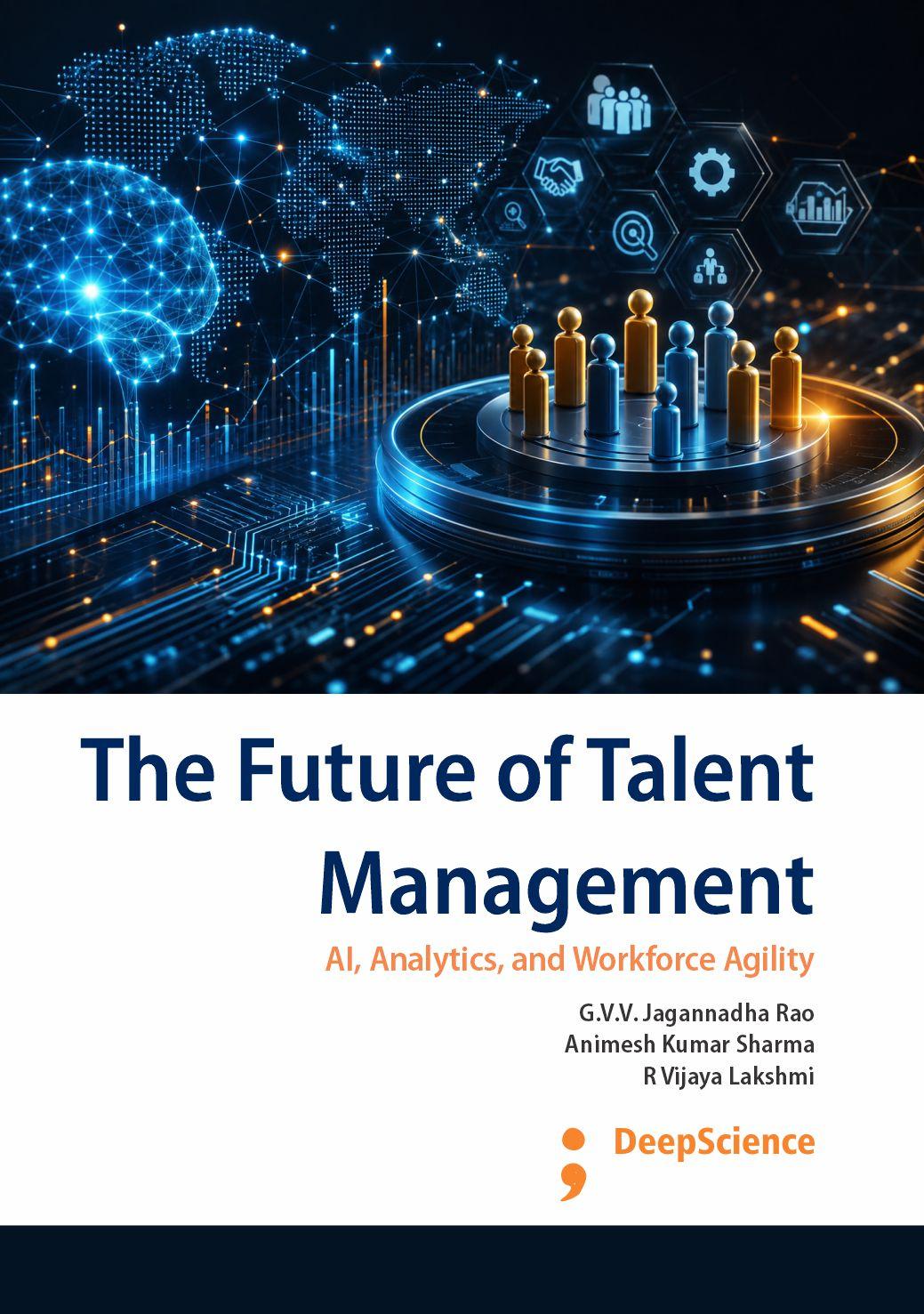
The Future of Talent Management: AI, Analytics, and Workforce Agility
##plugins.pubIds.doi.readerDisplayName##
https://doi.org/10.70593/978-93-7185-913-4
Keywords:
Talent Management, Artificial Intelligence, Workforce Agility, Workforce Analytics, Performance Management, Talent Retention, Talent IntelligenceSynopsis
Change in the world of work is occurring faster than ever before. The Global Employer Brand is evolving and changing as the result of advances in these areas, Artificial Intelligence, Workforce Analytics, Automation, Digital Transformation, and Changing Employee Expectations. In this dynamic environment, old fashioned talent management approaches, are no longer enough. Agility and responsiveness to change requires an organization's approach to be agile, data-informed and people-centred.
Benefiting from insights from technologists and business leaders, The Future of Talent Management: AI, Analytics, and Workforce Agility examines the new forces reshaping the landscape of talent management and what organizations can do to ensure their employees are prepared for the age of AI, analytics, and workforce agility. New opportunities are emerging around artificial intelligence and its use to enhance recruitment, learning, performance management, workforce planning and employee experiences. Meanwhile, people analytics is fueling the creation of actionable insights and informed decisions from workforce data.
But technology isn't the only thing that may be the shape of talent management's future. Recognizing the importance, ethical aspects, trust of the employees, privacy, inclusion, leadership, creativity, and human judgement remain equally important. Elements that make up a workforce-ready organization include flexible workplaces, internal mobility, ongoing learning and development and adaptable skills.
This book integrates these aspects and offers a hands-on and forward-looking insight into talent management. It is designed for HR professionals, managers, business leaders, educators, students and researchers interested in learning more about the evolving landscape of the world of work and workforce strategy.
Now is the time for organisations to embrace future opportunities to integrate the intelligence of technology with the potential of people. The aim of this book is to help readers confront that future with increased awareness, understanding and direction.
References
Aguinis, H. (2023). Performance management (5th ed.). Chicago Business Press.
Alavi, M., & Leidner, D. E. (2021). Knowledge management and knowledge management systems: Conceptual foundations and research issues. MIS Quarterly, 25(1), 107–136.
Armstrong, M. (2023). Armstrong's handbook of human resource management practice (16th ed.). Kogan Page.
Autor, D. H. (2022). The labor market impacts of technological change. National Bureau of Economic Research Working Paper.
Bersin, J. (2021). Irresistible: The seven secrets of the world's most enduring, employee-focused organizations. Josh Bersin Academy.
Bock, L. (2015). Work rules!: Insights from inside Google that will transform how you live and lead. Twelve.
Bondarouk, T., Parry, E., & Furtmueller, E. (2021). Electronic HRM: Four decades of research on adoption and consequences. International Journal of Human Resource Management, 28(1), 98–131.
Boudreau, J. W., & Cascio, W. F. (2022). Human capital analytics: How to harness the potential of your organization's greatest asset. Pearson.
Brynjolfsson, E., & McAfee, A. (2017). The second machine age: Work, progress, and prosperity in a time of brilliant technologies. W. W. Norton.
Cappelli, P. (2020). Talent on demand: Managing talent in an age of uncertainty. Harvard Business Review Press.
Cappelli, P., & Keller, J. R. (2021). Talent management: Conceptual approaches and practical challenges. Annual Review of Organizational Psychology and Organizational Behavior, 8, 197–219.
Cascio, W. F., & Montealegre, R. (2021). How technology is changing work and organizations. Annual Review of Organizational Psychology and Organizational Behavior, 3, 349–375.
CIPD. (2024). People profession survey 2024. Chartered Institute of Personnel and Development.
Davenport, T. H., & Kirby, J. (2022). The AI advantage: How to put artificial intelligence revolution to work. MIT Press.
Davenport, T. H., Harris, J., & Shapiro, J. (2010). Competing on talent analytics. Harvard Business Review, 88(10), 52–58.
Deloitte. (2024). Global Human Capital Trends 2024. Deloitte Insights.
Dwivedi, Y. K., Hughes, L., Ismagilova, E., et al. (2023). Artificial Intelligence (AI): Multidisciplinary perspectives on emerging challenges, opportunities, and agenda for research, practice and policy. International Journal of Information Management, 57, 101994.
European Commission. (2024). Artificial Intelligence Act. European Union.
Fitz-enz, J., & Mattox, J. (2021). Predictive analytics for human resources. Wiley.
Floridi, L. (2023). The ethics of artificial intelligence. Oxford University Press.
Floridi, L., & Cowls, J. (2019). A unified framework of five principles for AI in society. Harvard Data Science Review.
Gartner. (2024). Top strategic technology trends 2024. Gartner Research.
George, G., Lakhani, K. R., & Puranam, P. (2023). What has changed? The impact of artificial intelligence on the future of management. Academy of Management Discoveries.
Goleman, D. (2021). Emotional intelligence (25th Anniversary ed.). Bantam Books.
Goodfellow, I., Bengio, Y., & Courville, A. (2016). Deep learning. MIT Press.
Harvard Business Review. (2023). The future of work special issue. Harvard Business Publishing.
International Labour Organization. (2023). World employment and social outlook: Trends 2023. ILO.
ISO. (2024). ISO/IEC 42001: Artificial intelligence management systems. International Organization for Standardization.
Kaplan, R. S., & Norton, D. P. (2008). The execution premium. Harvard Business School Press.
Kiron, D., Prentice, P. K., & Ferguson, R. B. (2022). The analytics mandate. MIT Sloan Management Review.
KPMG. (2024). Global AI in HR survey 2024. KPMG International.
Manyika, J., et al. (2023). The future of work after COVID-19. McKinsey Global Institute.
McKinsey & Company. (2023). The state of organizations 2023. McKinsey Global Institute.
Noe, R. A. (2023). Employee training and development (9th ed.). McGraw-Hill Education.
NIST. (2023). Artificial Intelligence Risk Management Framework (AI RMF 1.0). National Institute of Standards and Technology.
OECD. (2023). OECD employment outlook 2023: Artificial intelligence and the labour market. OECD Publishing.
Parry, E., Strohmeier, S., & Bondarouk, T. (2022). Digital human resource management: Concepts and future directions. International Journal of Human Resource Management.
PwC. (2024). Global workforce hopes and fears survey 2024. PricewaterhouseCoopers.
Russell, S., & Norvig, P. (2021). Artificial intelligence: A modern approach (4th ed.). Pearson.
Schwab, K. (2017). The fourth industrial revolution. Crown Business.
SHRM. (2024). State of the workplace report 2024. Society for Human Resource Management.
Tambe, P., Cappelli, P., & Yakubovich, V. (2019). Artificial intelligence in human resources management: Challenges and opportunities. California Management Review, 61(4), 15–42.
UNESCO. (2021). Recommendation on the ethics of artificial intelligence. UNESCO.
United Nations. (2015). Transforming our world: The 2030 agenda for sustainable development. United Nations.
Vrontis, D., Christofi, M., Pereira, V., Tarba, S., Makrides, A., & Trichina, E. (2022). Artificial intelligence, robotics, advanced technologies and human resource management: A systematic review. The International Journal of Human Resource Management, 33(6), 1237–1266.
Westerman, G., Bonnet, D., & McAfee, A. (2014). Leading digital: Turning technology into business transformation. Harvard Business Review Press.
World Economic Forum. (2023). The future of jobs report 2023. World Economic Forum.
World Economic Forum. (2025). The future of jobs report 2025. World Economic Forum.
Published
4 August 2026
Copyright (c) 2026 G.V.V.J agannadha Rao, Animesh Kumar Sharma, R Vijaya Lakshmi
Details about the available publication format: E-Book
E-Book
ISBN-13 (15)
978-93-7185-913-4
Details about the available publication format: Book (Paperback)
Book (Paperback)
ISBN-13 (15)
978-93-7185-914-1
How to Cite
Rao, G. agannadha ., Sharma, A. K. ., & Lakshmi, R. V. . (2026). The Future of Talent Management: AI, Analytics, and Workforce Agility. Deep Science Publishing. https://doi.org/10.70593/978-93-7185-913-4
Download Citation






 WhatsApp +91 7977171947