
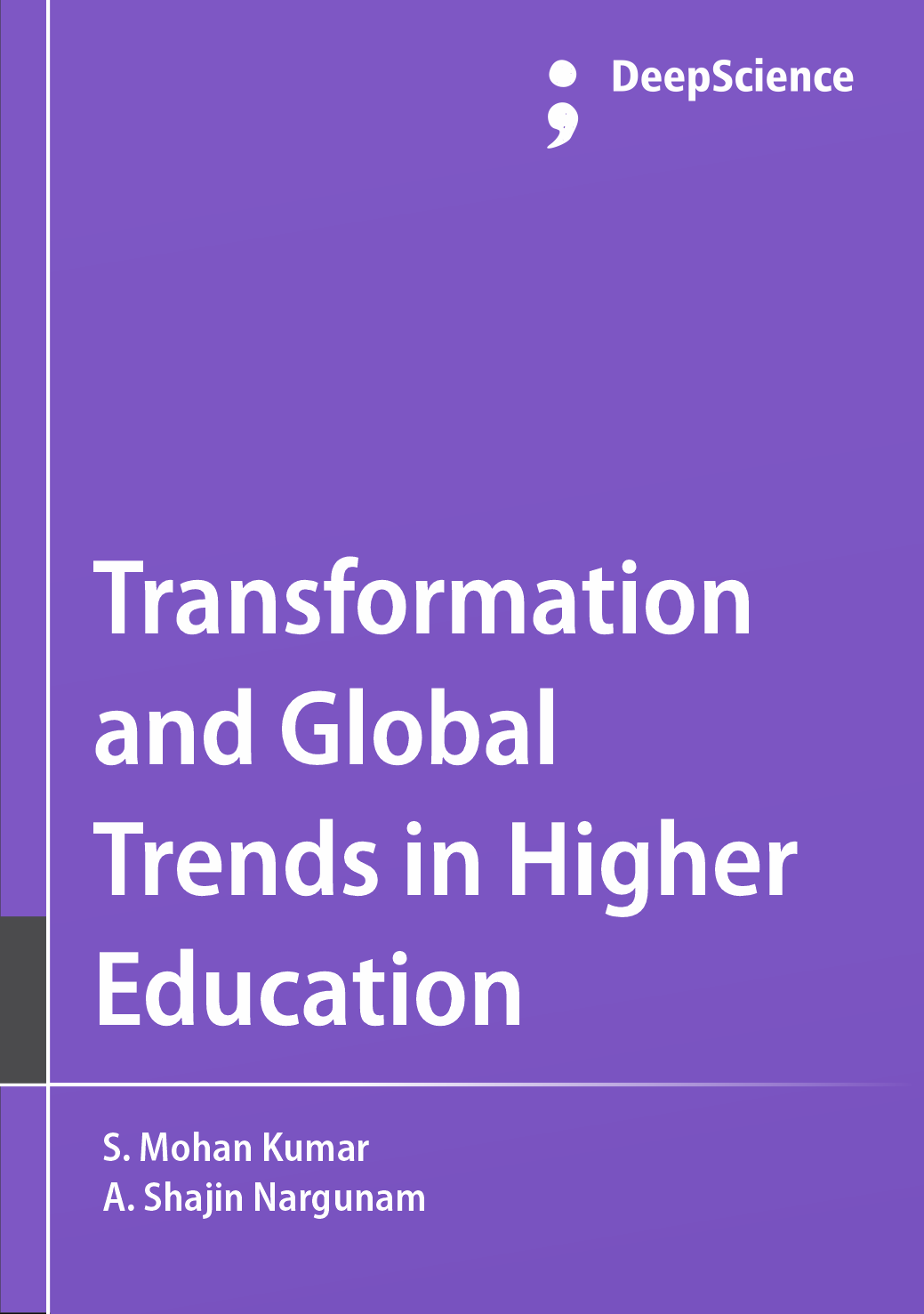
Transformation and Global Trends in Higher Education
##plugins.pubIds.doi.readerDisplayName##
https://doi.org/10.70593/978-81-69589-78-9
Keywords:
Higher Education, Agile Learning, Curriculum Development, Administrative Restructuring, Chronological research, Digital Learning, Student EngagementSynopsis
The world of higher education is rapidly evolving. Universities are compelled to evolve and respond to technology, globalization, changing jobs requirements, artificial intelligence and flexible learning. Colleges and universities need to be more flexible and ready to meet society's and the economy's new needs. Many valuable reflections on the future of higher education are contained in this book. It looks at how universities need to adapt their approach in strategy, pedagogy, research, and commercial links, to remain relevant in the changing world.
Asia now is a hub for higher education, research and technology. A number of Asian countries are creating new policies to promote quality, international connections, employability, digital education, flexible learning programmes, and research. They're also collaborating with industry now more closely. Institutions gain insights into strengthening their education systems and make them more competitive by understanding these changes.
There must continue to be a transformation in engineering education. Students have to be prepared for new skills in emerging areas such as artificial intelligence, robotics, advanced manufacturing, renewable energy, semiconductors, cyber-security and smart technologies. Hands-on learning, feedback, problem solving, teamwork and cross-disciplinary learning are all part of flexible learning approaches to prepare engineers for the future. It is also necessary to make higher education help students to develop their critical thinking, creativity, ethics, leadership, communication and social responsibility. Technology should enhance human growth, not be a substitute to the educational values.
This text provides an opportunity for educators, researchers, leaders, policymakers and industry professionals to gain insight into emerging trends and enhancements for education. The essays and thoughts contained in this volume are intended to offer encouragement for dialogue, innovation and partnerships, and new reform efforts in higher education. This publication aspires to contribute to the creation of higher education systems that are flexible, inclusive, world open, technologically well-equipped and serve society.
References
A., S. D., & Sylqa, D. (2025). Curriculum and academic strategy transformation in higher education: A case study of socioeconomic impact. Lingua Montenegrina , . https://doi.org/10.46584/lm.v36i2.1131
Abadi, N., & Elbaz, D. (2023). Enhancing civil engineering education through innovative stem methodologies. International academic journal of innovative re-search, 10 (4), 19-24. https://doi.org/10.71086/iajir/v10i4/iajir1028
Abdukhalilovich, R. B. (2025). AI and the digital economy: Reshaping higher education for the future. https://doi.org/10.5281/zenodo.14924906
Abulibdeh, A., Chatti, C. B., Alkhereibi, A. H., & Menshawy, S. E. (2025). A scoping research of the strategic integration of artificial intelligence in higher educa-tion: Transforming university excellence themes and strategic planning in the digital era. European Journal of Education, 60 (1), . https://doi.org/10.1111/ejed.12908
Achariya, A., & Achariya, A. (2025). Artificial intelligence as a catalyst for transforming learning in higher education. Perfect Education Fairy, 3 (3), 80-87.
Published
30 August 2026
Copyright (c) 2026 S. Mohan Kumar, A. Shajin Nargunam
Details about the available publication format: E-Book
E-Book
ISBN-13 (15)
978-81-69589-78-9
Details about the available publication format: Book (Paperback)
Book (Paperback)
ISBN-13 (15)
978-81-69589-79-6
How to Cite
Kumar, S. M. ., & Nargunam, A. S. . (2026). Transformation and Global Trends in Higher Education. Deep Science Publishing. https://doi.org/10.70593/978-81-69589-78-9
Download Citation






 WhatsApp +91 7977171947