

Intelligent Automation and Self-Optimizing Workflow
Synopsis
Although often treated as a synonym for Robotic Process Automation (RPA), Automation is more accurately viewed as an umbrella term encompassing a wide variety of techniques for automating repetitive tasks. Intelligent Automation (IA) increases process efficiency across all business functions by combining several innovative technologies, including RPA and other low-code or no-code solutions that require little to no programming skills. It involves integrating intelligent solutions that require a certain degree of automation for development and integration (e.g., machine learning, interaction with RPA), and can incorporate decision support tools. Unlike some earlier definitions, IA does not require that the process be completely hands-free. In addition to facilitating the automation of transactional work—offloading data entry and other digital tasks, as well as executing straight-through processing—IA also provides a framework for enabling traditional back-office process owners to extend their responsibility into the automation domain. By automating routine tasks, employees can focus on working with customers and carrying out their core responsibilities. Furthermore, these technology patterns are maturing rapidly, with new entrants and innovations emerging faster than users can evaluate and pilot them.
Downloads
Pages
126-142
Published
9 April 2026
Copyright (c) 2026 Kushvanth Chowdary Nagabhyru
How to Cite
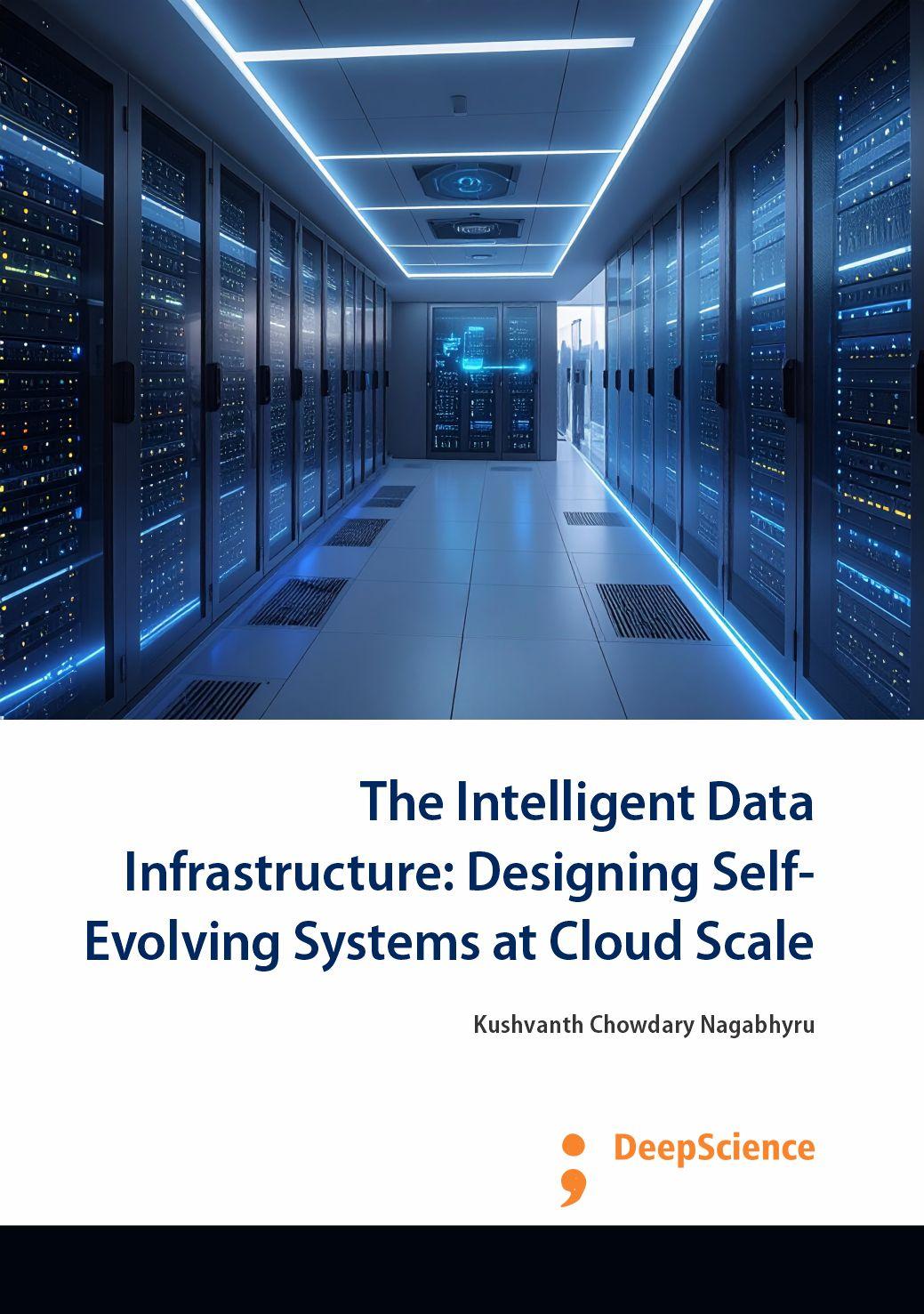
Kushvanth Chowdary Nagabhyru. (2026). Intelligent Automation and Self-Optimizing Workflow. In The Intelligent Data Infrastructure: Designing Self-Evolving Systems at Cloud Scale (pp. 126-142). Deep Science Publishing. https://doi.org/10.70593/978-93-7185-126-8_8
Download Citation









 WhatsApp +91 7977171947