

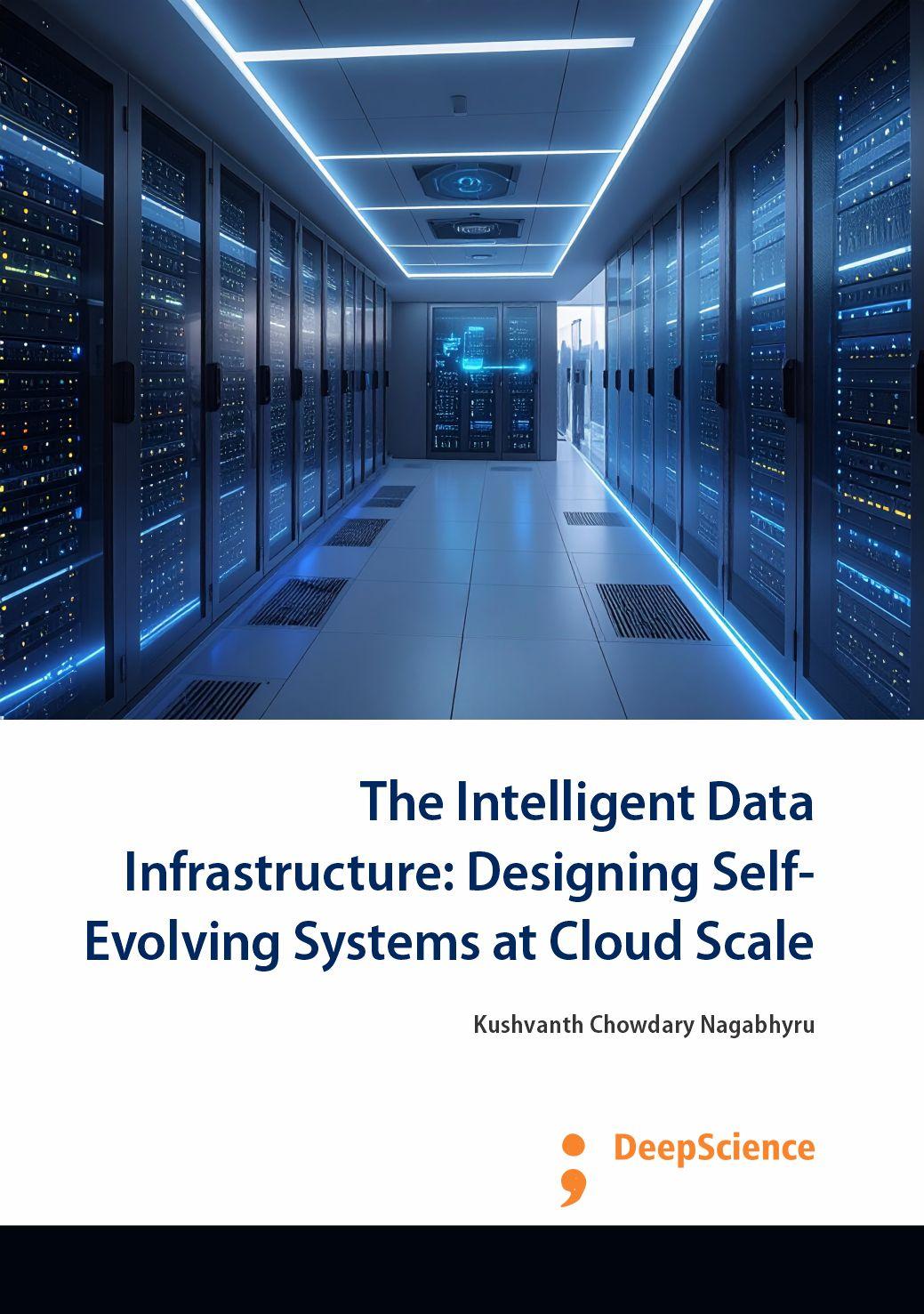
The Intelligent Data Infrastructure: Designing Self-Evolving Systems at Cloud Scale
##plugins.pubIds.doi.readerDisplayName##
https://doi.org/10.70593/978-93-7185-126-8
Keywords:
Data Infrastructure, Cloud Scale, Data Ingestion, Data Processing, Storage Architectures, Machine Learning, Data PlatformsSynopsis
Data no longer waits to be managed; it evolves, adapts, and demands that the systems housing it do the same.
When I began writing The Intelligent Data Infrastructure: Designing Self-Evolving Systems at Cloud Scale, the central question driving me was deceptively simple: why do so many sophisticated data platforms, built with enormous investment and technical talent, still require constant human intervention to remain useful? The answer, I came to believe, lies not in the tools we choose but in a foundational assumption we have carried forward unchallenged that data infrastructure is something you build, stabilize, and maintain. This book argues the opposite. The next generation of data infrastructure must be something that builds, stabilizes, and maintains itself.
Self-evolving systems are not science fiction. They are the logical destination of converging forces already reshaping cloud-native engineering: autonomous schema adaptation, AI-driven capacity orchestration, continuous quality feedback loops, and event-driven architectures that respond to change at machine speed. What has been missing is a coherent engineering philosophy that ties these capabilities together into systems designed for intelligent autonomy from the ground up.
This book is that philosophy, made concrete.
The chapters that follow move from first principles what it means for infrastructure to be "intelligent" through practical architecture patterns for self-healing pipelines, adaptive governance, and cost-aware auto-scaling at cloud scale. Each concept is grounded in real engineering decisions: the trade-offs, the failure modes, and the organizational realities that determine whether an autonomous system liberates its operators or simply moves the complexity somewhere less visible.
This work is written for architects, senior engineers, and technical leaders who sense that the era of purely hand-operated data infrastructure is ending and who want to be the ones designing what comes next. The infrastructure of the future does not ask for instructions. It learns.
Chapters
-
Foundations of Intelligent Data Infrastructure
-
Architectural Principles for Cloud-Scale Data Systems
-
Real-Time Data Ingestion and Streaming Pipelines
-
Distributed Data Processing and Storage Architectures
-
Integrating Machine Learning into Data Platforms
-
Generative and Autonomous Systems in Data Engineering
-
IoT Data Integration and Edge-to-Cloud Intelligence
-
Intelligent Automation and Self-Optimizing Workflow
-
Data Governance, Security, and Trust at Scale
-
Future Directions in Self-Evolving Data Ecosystems
References
Kandel, S., Paepcke, A., Hellerstein, J. M., & Heer, J. (2012). Enterprise data analysis and visualization: An interview study. IEEE Transactions on Visualization and Computer Graphics, 18(12), 2917–2926.
Amistapuram, K. Energy-Efficient System Design for High-Volume Insurance Applications in Cloud-Native Environments. International Journal of Innovative Research in Electrical, Electronics, Instrumentation and Control Engineering (IJIREEICE).
Heer, J., Hellerstein, J. M., & Satyanarayan, A. (2015). Voyager 2: Augmenting visual analysis with partial view specifications. In Proceedings of the 2015 CHI Conference on Human Factors in Computing Systems (pp. 1–10).
Segireddy, A. R. (2020). Cloud Migration Strategies for High-Volume Financial Messaging Systems.
Satyanarayan, A., Moritz, D., Wongsuphasawat, K., & Heer, J. (2017). Vega-Lite: A grammar of interactive graphics. IEEE Transactions on Visualization and Computer Graphics, 23(1), 341–350.
Thutari, R. T., Garapati, R. S., BM, M., & RK, S. (2025, October). Adaptive Access Control and Authentication Management for IoT Using Attention-GRU and Reinforcement Learning. In 2025 2nd International Conference on Software, Systems and Information Technology (SSITCON) (pp. 1-6). IEEE.
Downloads
Published
9 April 2026
Copyright (c) 2026 Kushvanth Chowdary Nagabhyru
Details about the available publication format: E-Book
E-Book
ISBN-13 (15)
978-93-7185-126-8
Details about the available publication format: Book (Paperback)
Book (Paperback)
ISBN-13 (15)
978-93-7185-570-9
How to Cite
Kushvanth Chowdary Nagabhyru. (2026). The Intelligent Data Infrastructure: Designing Self-Evolving Systems at Cloud Scale. Deep Science Publishing. https://doi.org/10.70593/978-93-7185-126-8
Download Citation










 WhatsApp +91 7977171947