

The Healthcare Intelligence Graph: Designing Adaptive and Interconnected Clinical Platforms
##plugins.pubIds.doi.readerDisplayName##
https://doi.org/10.70593/978-93-7185-978-3
Keywords:
Healthcare, Clinical Platforms, Data Platforms, Clinical Data, Medical, Multi-Agent Learning, Healthcare SystemsSynopsis
Healthcare has always been a domain of relationships between clinician and patient, between diagnosis and treatment, between institutions and populations. Yet for decades, the digital systems built to support those relationships have done the opposite: fragmenting data into silos, isolating departments behind incompatible protocols, and forcing care teams to reconstruct the full picture of a patient's journey from disconnected fragments.
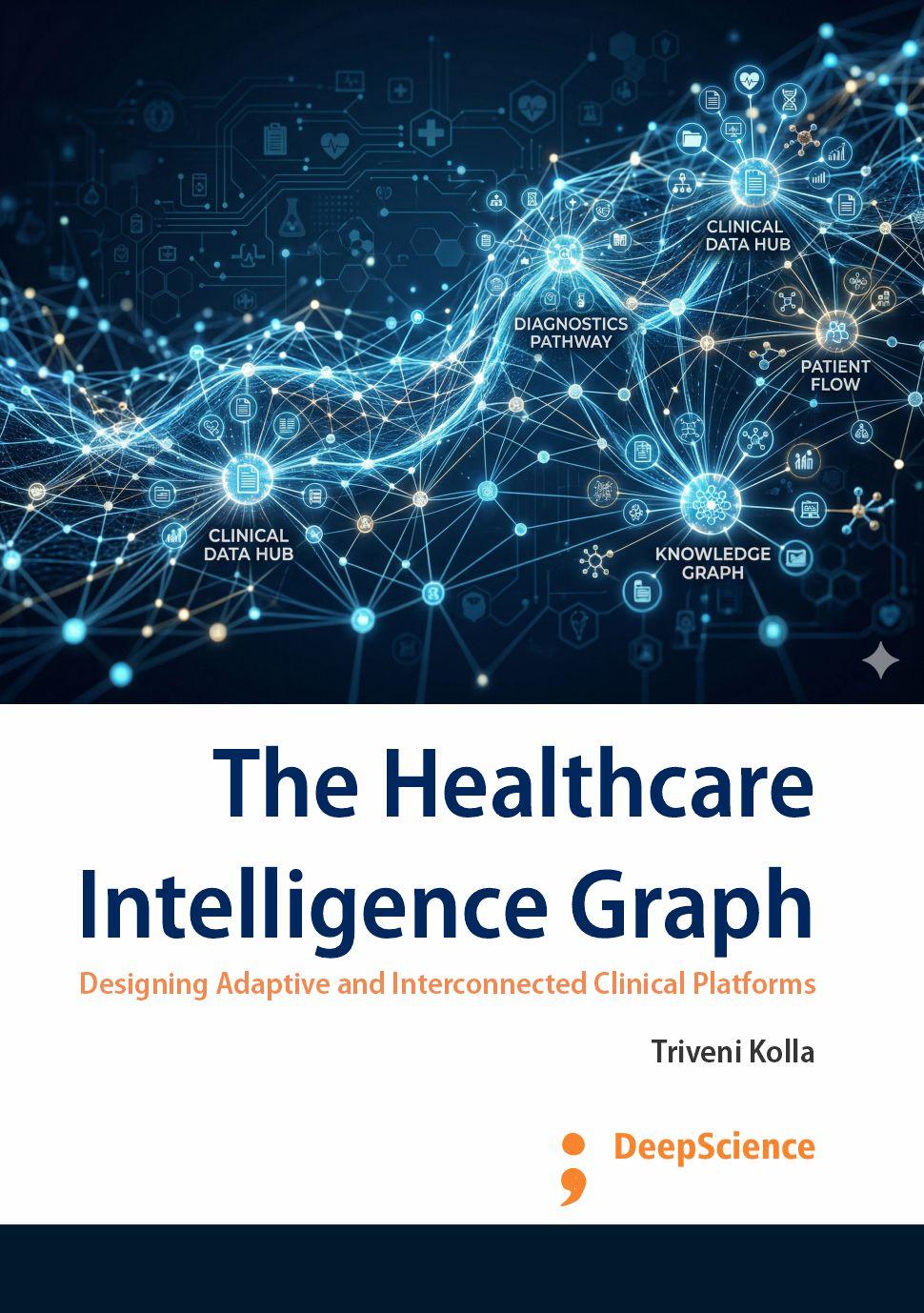
This book emerges from a conviction that the next decisive shift in clinical technology will not be a faster database or a smarter algorithm in isolation, it will be the graph: a living, interconnected representation of clinical knowledge, patient context, institutional workflow, and real-time signals, all woven into a single adaptive fabric.
The healthcare intelligence graph is not a product or a standard. It is an architectural philosophy one that treats every patient encounter, every diagnostic event, every care pathway as a node in a broader network of meaning. When those nodes are connected intelligently, patterns emerge that no single system could reveal alone: early warning signals hidden across time, care gaps invisible in point-of-care views, populations at risk obscured behind aggregate statistics.
The chapters that follow explore how to design, build, and govern such platforms from the data models and integration layers that form their foundation, to the AI and reasoning engines that make them adaptive, to the governance and interoperability frameworks that make them trustworthy. The engineering challenges are real. So are the ethical stakes. A system that connects clinical intelligence must be designed with as much care for privacy, equity, and human oversight as for performance.
This book is written for architects, clinicians, and technologists who believe that better-connected knowledge systems can measurably improve care and who are willing to do the disciplined work of building them.
Chapters
-
Foundations of the Healthcare Intelligence Graph
-
Architecture of Interconnected Clinical Data Platforms
-
Data Integration and Interoperability Frameworks
-
Real-Time Clinical Data Exchange and Streaming Systems
-
Graph-Based Modeling for Healthcare Data Relationships
-
Machine Learning for Clinical Pattern Discovery
-
Generative Models for Clinical Data Augmentation
-
Intelligent Medical Coding and Risk Adjustment Systems
-
Multi-Agent Learning for Adaptive Clinical Decision-Making
-
Future Directions in Autonomous and Interconnected Healthcare Systems
References
Kandel, S., Paepcke, A., Hellerstein, J. M., & Heer, J. (2012). Enterprise data analysis and visualization: An interview study. IEEE Transactions on Visualization and Computer Graphics, 18(12), 2917–2926.
Heer, J., Hellerstein, J. M., & Satyanarayan, A. (2015). Voyager 2: Augmenting visual analysis with partial view specifications. In Proceedings of the 2015 CHI Conference on Human Factors in Computing Systems (pp. 1–10).
Segireddy, A. R. (2020). Cloud Migration Strategies for High-Volume Financial Messaging Systems.
Satyanarayan, A., Moritz, D., Wongsuphasawat, K., & Heer, J. (2017). Vega-Lite: A grammar of interactive graphics. IEEE Transactions on Visualization and Computer Graphics, 23(1), 341–350.
Downloads
Published
9 April 2026
Copyright (c) 2026 Triveni Kolla
Details about the available publication format: E-Book
E-Book
ISBN-13 (15)
978-93-7185-978-3
Details about the available publication format: Book (Paperback)
Book (Paperback)
ISBN-13 (15)
978-93-7185-331-6
How to Cite
Kolla, T. . (2026). The Healthcare Intelligence Graph: Designing Adaptive and Interconnected Clinical Platforms. Deep Science Publishing. https://doi.org/10.70593/978-93-7185-978-3
Download Citation










 WhatsApp +91 7977171947